Author: kjbeadling

Unknown's avatar

About kjbeadling

mission-driven entrepreneur, dad, husband, little league coach, teacher, happy warrior, dukie, bay swimmer, composter/recycler, former lawyer, blogger-maybe not in that order.

Enter the Dragon

Image


If I think about it, there are a number of threads in my life that I have left too short.  A number of choices to stop chasing after something or an inability to muster the motivation to keep something going.  It’s easy to blame dropping a thread on the Egyptians and Hipparchus.  The Egyptians allegedly bear responsibility for the 24 hour day.  They counted finger joints, not fingers, to get to the number “12” on each hand.   The Greek Hipparchus later came up with the idea of dividing a day into 24 equal hours, based upon 12 hours of daylight and 12 hours of darkness on the days of the Equinoxes.  

This astronomy lesson shouldn’t obscure the fact that I’ve dropped a couple important threads.  At least one of those, I’m pretty sure, was a big mistake.  Karate.

My father is fond of telling the story about how he dragged me to a karate studio in a suburb outside of Syracuse, New York when I was maybe six years-old.  This would have been circa 1974, before karate became more mainstream, I suppose.  In any event, apparently I enjoyed the experience until I was punched in the gut for the first time.  I have a vague recollection of that sickening feeling, the breath suddenly knocked out of the lungs in my pipsqueak body.  That is the feeling of wanting to quit. 

I don’t remember the exact timing, but I understand that I gave into that queasy, unfamiliar feeling, and quit.  Went back to maybe Little League, Nerf basketball, and Rock ‘Em Sock ‘Em Robots. Pursuits that don’t promise the threat of delivering up the feeling of wanting to quit.

As a senior at Duke some 15 years later, I picked “karate” out of the Physical Education section of the book of classes.  My diet during undergrad was heavily weighted towards barley, yeast, hops, and the water used in the brewing process.  I figured I could counteract some of that with a semester or two of profuse sweating in a thick karate gi on Thursday mornings.  As i think about it now, I suspect that I may also have been drawn back to karate because I didn’t feel good about giving in to that feeling of quitting first introduced to me 130 pounds ago.  But I probably couldn’t have articulated that vague motivation as a 20 year-old.  I managed to enjoy the class, push through some keg party hangovers, and progress a bit such that I caught just a glimpse of something unique about this particular thread.  Something visceral that would stick with me.

But graduation that spring pulled the thread out of my hand.  And a year of adjusting to law school perpetuated the notion in my head that karate was over for me.  Just a phys ed class I happened to take in undergrad.  And that gym on Duke’s East Campus is a long way from the cold winters of Cleveland and these thick Contracts textbooks. 

At some point, while banging around on some Nautilus machine or another, I spied a group of people sliding around on a small, wood-floored room upstairs at my local gym.  They kept to themselves.  They were not physical specimens.  The gent who seemed to be leading them through their various motions appeared tiny and meek when sitting on a bench across the locker room from me.  But they were intense, different from what I had experienced with karate to that point. They seemed to know something that I didn’t.  I was intrigued.

I don’t exactly remember how or when I managed to show up at the door to their training room, their dojo, for the first time.  But I do remember that I knew immediately how important this thread would be.  Despite the time-constraints of law school, I stayed committed to this new pursuit.  It was time-consuming on its own and very challenging.  It showed me the feeling of wanting to quit during just about every practice. 

And in case the feeling wasn’t powerful enough, the people who practiced this type of karate regularly held events blandly called “Special Training.”  My first was in a basketball gym at a nondescript college somewhere outside Pittsburgh.  A full weekend, totally focused on karate.  Jamming several years worth of facing the feeling, facing your fears, into a single, sleep-deprived weekend. 

There was plenty of fear stemming from sparring with a superior partner, or rather, a whole series of superior partners, bent on delivering a crunching punch to my nose.  And these guys did not wear big plastic cushioned gloves.  Just very thin gloves like cycling gloves, primarily to avoid the transfer of bodily fluids from puncher to punchee.  I can still imagine their faces, piercing blue eyes holding mine, poised an arm’s length away, ready to knife across that distance in such a way that I can’t perceive their movement until it is too late.  

But that piece wasn’t the one that taught me the feeling most powerfully, that made me want to quit, want to cry, want to vomit maybe, made me feel like a tiny 6 year-old with the wind knocked out of him.  That teacher would be Kiba Dachi or “horse stance.”  We all gathered in a concentric circles, spread our bare feet apart, then dropped our hips probably half way to our knees.  Then stayed there.  For an hour and a half.  No breaks.  No standing up.  Just you, your unfathomable leg pain, your breathing, and the feeling of wanting to quit.  Your fears.  Facing that feeling for 90 straight minutes, dripping sweat, watching a handful of others literally pass out and fall over as the blood in their heart pulled down to fuel their shaking legs at the expense of their brains.  Watching several throw up into the inside folds of their gi tops, so as to avoid being impolite, and never straightening their legs through this.  

That horse stance at Special Training was the most difficult thing I have ever experienced.  I earned a black belt shortly after law school graduation and continued training for a few more years while living in Boston.  I held the thread tightly, then let it go when we moved to San Francisco 15 years ago.

I think about karate a lot.  I’ve found other things along the way that provide me with the hint of that feeling of wanting to quit, I suppose.  But I don’t think it’s as pure as that horse stance. 

A few times each year, I check out the local Shotokan Karate website, actually do the math of seeing whether I could possibly jam practices into our family calendar.  Egyptians and Hipparchus still working their evil, I tell myself.  But I am afraid.  It has been a long time since I faced my fears in the powerful way that only karate and that 90-minute horse stance can deliver up.  And I am afraid.

Thanks for reading.  

Note: The fantastic dragon mural pictured at the top of this blog entry is the work of a gifted local artist named Zio Ziegler.  This particular piece graces a wall in the library of my kids’ K-8 school.  I happened to tweet about the photo yesterday during parent-teacher conferences.  My dad saw my tweet and reminded me that a very similar-looking dragon painting adorned one of the large picture windows at that Syracuse karate dojo where I first experienced wanting to quit, nearly 40 years ago.  Funny how life works, eh? 🙂

Five-Second Rule? How about the Five-Year Rule??

ImageMy Facebook feed this morning delivered up a post by Outside Magazine, citing a New York Daily News article, that reported on a recent study from researchers at Ashton University in the UK.  The Six Degrees of Kevin Bacon point?  It turns out the amount of time a morsel of food spends on the ground bears a direct correlation to whether you should pick up the morsel and eat it.  Interesting study.  Interesting conclusion.  Good to know. 

I think the researchers set their sights too low, however.  They apparently stopped the clock at 30 seconds of floor contact.  I think they should have measured the bacteria count after a number of years, forget about seconds.  And the hypothesis tested should be the point after which the discarded or forgotten or newly-discovered morsel will kill the prospective eater. 

That sweet photo of the pudgy-toed toddler and upside down ice cream cone in the photo above, smartly deployed by Outside Magazine courtesy of Getty Images?  That’s nothin’.  I don’t know any parent who hasn’t dealt with that kind of pedestrian incident, walking down a dark, gum-spot covered sidewalk, not even breaking stride.  The sand or topsoil or even minute shards of glass just make the ice cream treat all the more unique.  Kidding about the glass shards.  I think.

I’m more interested in whether the energy gel I recently ate will make me drop dead while mashing it up in my mouth, or maybe give me gangrene of the belly in a few hours or days. 

You see, in a pinch, I will eat just about anything.  This is the case mostly due to the fact that I’ve been burning (a slow burn, mind you) through running shoes, bike seats, and swim goggles for 15 or 16 years now.  Upon leaving private law practice, I took up representing some professional endurance athletes, helping them with sponsorship and such.  And soon thereafter, I bought a local marathon.  That meant that I had access to storage lockers full of Zone Perfect bars, PowerBar gels, Clifbars, Clif Shots, Accelerade, Sport Beanz, Endurox, and bags and bottles full of dozens of products I simply can’t bring back to mind all these years later.  All this stuff basically fueled my mediocre competitive triathlon “career” as an age grouper.  For longer than my kids have been alive.

And it’s all gone.  The piles of boxes are long gone.

Except for the occasional bar or gel or bean or powder in a Ziploc bag that I’ll scrape from the bottom of a backpack I’ve unearthed in the back of a closet.  Or scooped out of my older son’s bedside table drawer, chocked full of goodies from when the drawer belonged to me.  Or stuffed into the pocket of a jacket I haven’t worn for years. 

Example. I used to love the “green apple” gels that PowerBar made.  I had a ton of those from, oh, maybe 2001.  As I recall, they had some sort of caffeine or similar ingredient in there.  I made the mistake of leaving a few unopened packs on a shelf in my garage after a long bike ride around the 2001 time frame.  A day or two later, I discovered that some mice had themselves discovered that they too enjoyed the green apple gels.  The telltale nibble marks, the speck-sized mouse poop scattered about.  There is no warning label on the gel packets regarding proper consumption amounts for vermin, or that the gel is not intended for vermin.  But I can tell you there should be. 

A section of the garage was practically ripped apart by that mouse or mice all hopped up on the green apple gel.  The evidence of the mouse or mice activity suggested that the critters leapt with super-human (super-vermin?) powers, accessing high spaces and walls in a way that was just not normal. That little bastard or those little bastards pretty much destroyed the last of those green apple PowerGels.  And I think they paid the ultimate price, most likely.  Tweaked out after a few hours of their caffeine-addled manic behavior, simply expiring in a little heap in one hole or another somewhere.  Spent.

Serves them right.  And fortunately, they didn’t find all of my green apple gel stash.

I found one of these wonder gels just the other day, in a red and grey Timbuk2 messenger bag that saw regular circulation years ago as Max’s diaper bag.  Max is now 12.  I spied in a weird little pocket the gold-tinted packet, the green apple graphic, and I couldn’t resist.  Mostly, I was pressed for time, trying to squeeze in a compressed bike ride with a neighborhood buddy who was equally squeezed for time. I ripped the foil with my teeth, squeezed the paste (yes, it would no longer be accurate to call the texture “gel”) onto my tongue, and flattened out the packet to ensure that I got everything out.  My reptilian brain was screaming “NO EAT! NO EAT!” throughout this entire fifteen second episode, mind you.  I ignored it.

The ride was fine.  I suffered no ill effects from the gel, at least not yet.  And the really green apple paste served its purpose, as far as I can tell.  But my sample size was small.  The study was neither double-blind nor peer-reviewed.  So of limited scientific value.

So, to you researchers at Ashton University:  Thank you for the information.  But for your next study, may I suggest that you put away the stopwatch, and pull out the calendar?  Ideally a calendar that shows 10 or more years “at a glance”?  I may have another green apple gel or two around here somewhere, if you need something to test….

Thanks for reading.


I Saw Nessie Out There.

Image


I haven’t been in San Francisco Bay for almost two weeks.  That’s unusual, and I have been itchy about it.  Particularly since the Bay doesn’t really care about our indices of the Spring season.  Totally oblivious to the Vernal Equinox when day and night balance and the sun crosses the celestial equator nine days from today.   Couldn’t care less about Little League Opening Day.  San Francisco Bay remains chilly, and if you aspire to swim out there year round, it can be a bit risky to fall out of a twice-weekly swim routine.  It’s easy to lose the cold tolerance, I think.  

Fortunately, one of my neighborhood swim buddies was up for a pre-dawn swim this morning.  This despite the fact that it sounds like he anticipates enjoying a fun-filled root canal procedure later today.  It is admittedly peculiar that someone would pop out of bed an hour early to swim in the freezing Bay before the sun comes up; clutching his jaw in pain right up until it’s time to dive into the chop and get wet.  But it didn’t seem peculiar to me at all at the time, and probably not to him either.  Nor to the half-dozen other swimmers we criss-crossed–all of whom swam bareback–likely suffering from all manner of aches and pains that must be ignored and suppressed in the name of our shared addiction to icy water.  As I’ve written before, the whole thing is admittedly off-piste.  

And this morning, I was reminded why I keep going back. 

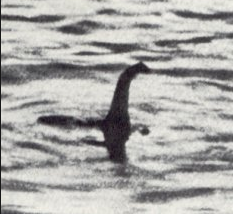
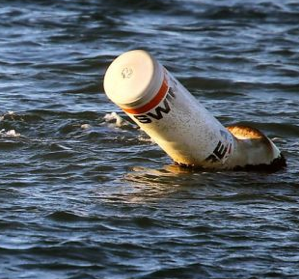
Unlike a temperature-controlled, black-lined pool, the Bay is ever-changing.  I think I’ve waded out into Aquatic Park a few hundred times over the years, and every swim is different.  There is something mystical about my first glimpse of the conditions, revealed only faintly in the pre-dawn light, or lack thereof.  Otherwise familiar landmarks (watermarks?) take on different forms.  For a split second, a cigarette buoy that I have known for 15 years looked exactly like that iconic Loch Ness Monster photo.  You know the one.  It’s the image we all think of when you read the words, “Loch Ness Monster.”  But just to make sure we’re on the same page, it’s this image —

Image

So for a brief moment, I thought the buoy pictured below might be Nessie —

Image

And my neighborhood swim buddy agreed, though the pain in his jaw may well have been impairing his judgment.  My judgment wasn’t impaired, just cut loose a little bit, intentionally suspended.  I like to conjure up a little manufactured magic to make the swim that much more interesting.  

Turns out I didn’t need to do much conjuring this morning.  The conditions were bizarre, the choppiest I have ever experienced out there.  Unfortunately, the photo at the top of this post, taken after we finished, simply doesn’t do justice to what went on out there.  The combination of general swell energy in the Pacific right now, a high tide reaching about 5 feet, and winds gusting up to 18 knots overnight and into the morning made for blustery, open ocean conditions.  I was reminded of the very sketchy conditions in the swim portion of the inaugural Ironman Utah twelve years ago.  Those conditions took a man’s life that day, so I know not to be cavalier about this kind of thing.  A morning unlike any other I can remember in Aquatic Park.

And I loved every second of it.  

We made a point of swimming in unusually close proximity to one another.  It would be easy to lose contact bobbing between 3-foot swells.  It took forever to make our way out to the “opening” where Aquatic Park opens up to the Bay proper, as I think of it.  Twice, I popped up when other swimmers suddenly appeared right in front of me, obscured by the waves until they were only a stroke or two ahead of me.  Always a little unnerving when this happens, given the food chain issues around here.  The leg back to shore was much faster.  We practically body-surfed our way back to the beach.  

We stumbled out numb, less than 30 minutes later, and turned around to look back out at the Bay.  I expected to see Nessie again, crashing waves, and “Victory at Sea” conditions.  But no, just the relatively placid morning captured in the photo at the top of this post. 

Had I imagined the whole thing?  I don’t think so, but it really doesn’t matter.  This is one I’ll remember for a long time. 

Thanks for reading. 


Get It Wherever and Whenever You Can.

Image

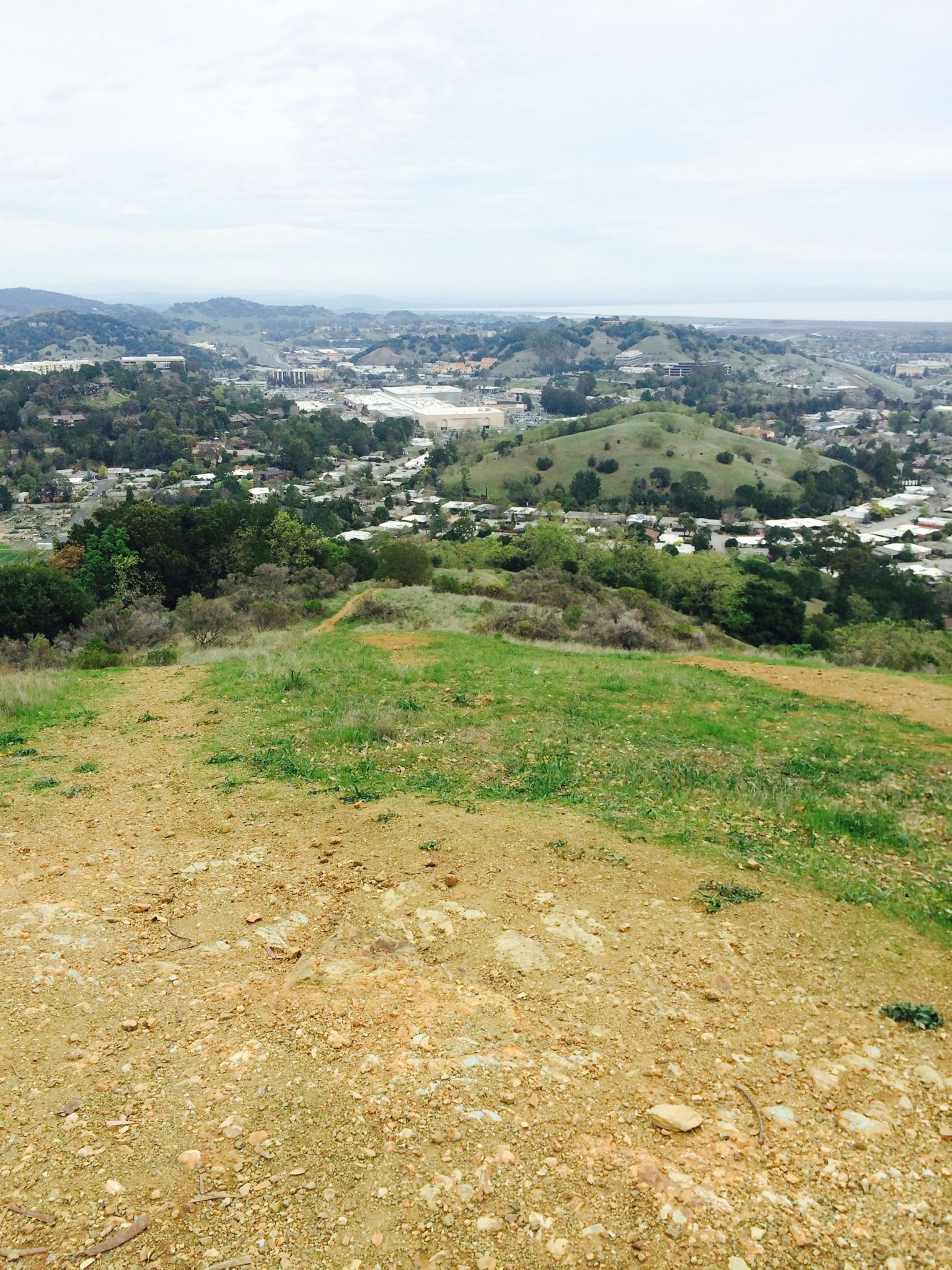
I am Super Dad.  This is the view that Super Dad took in whilst squeezing in an hour-long trail run before one of his son’s lacrosse games yesterday afternoon.   Can’t you hear the angels singing in the background?  The welcome scent of the pungent, local flora approaching springtime bloom?  Crystal mental clarity, all the senses running on all cylinders?  One with nature? I am Super Dad.

Plfft.  Hardly. 

A more realistic depiction of what squeezing training sessions into a busy schedule actually looks like would be a photo of a car trunk in which someone or something appears to be living.  Mismatched socks, the heels rubbed thin or missing in at least one.  A beach towel wide and long enough to give me cover for a tasteful change into shorts to run in.  Never mind if it’s a towel stretching Lightning McQueen’s toothy grin across my behind.  While standing in the parking lot, hopping on one leg, trying desperately to avoid attracting unwanted attention from other parents or children nearby.  “Mommy, what is that man doing??”  “Tommy, don’t look at him, DON’T LOOK AT HIM!”  And never mind if I grabbed the wrong towel from the linen closet at home, in a rush.  I can make do with a bath towel if need be.  It just means that I’ll need to clutch the corners at my hip with a vice grip, barely avoiding violating at least one local ordinance regarding public indecency.  And I’m not above using one of the dog’s pink, purple, or lime towels for this gaudy exercise in modesty, no matter how much dog hair and dog slobber resides on the towel.  

I’ve fallen in love with a new kind of shoe, too, and I think I’ve finally managed to find the perfect pair.  That also means that I wear the shoes every day, and for every run.  I’m told I should rotate shoes as a farmer rotate crops.  I refuse to let these shoes air out, to lie fallow.  The scent of long-expired roadkill emanating from the soles is a small price to pay for comfort.  My family doesn’t have any positives to associate with this particular negative since they don’t run in these fantastic shoes.  They associate the fantastic shoes only with a not-so-fantastic scent.  Collateral damage.  Super Dad has to get his run in, wherever and whenever he can. 

I know I’m pushing my luck with that last Super Dad reference, now that I’ve planted in your mind the image of the man in the parking lot clutching the Lightning McQueen towel at his waist and hopping around madly, the full length of his porcelain-white thigh flashing the nice families and perhaps scarring the younger children for life. 

I have my first triathlon in about ten years coming up, and my body is ten years older than it was then.  So I have to squeeze in these training sessions wherever and whenever I can. Hence the hopping  and flashing yesterday afternoon.

I had envisioned an hour-long romp in the rolling trails I spied on a crest overlooking my son Max’s lacrosse field in Terra Linda.  I had just enough time to dole myself out some meaningful punishment up there, I calculated.  I found a challenging loop marked off in one of the half-dozen running or hiking or biking apps cluttering one of my iPhone folders.  I’d managed to change into my running gear without incident.  Then I looked down now and saw that I’d hopped my way into a pair of bright, royal blue shorts.  The most ridiculous pair I own, handed to me with a smirk by my brother-in-law a year ago who used to work at Reebok.  I am reminded why this particular pair was given to him as a “sample.”  Because no one in their right mind would buy and wear these shorts in public.  But at this point, I’m in too deep and my remaining window until game time is running out.   

So I run. 

Easy at first, stumbling on a curb or two as I try to navigate my way to the trail head marked on the iPhone app with a green circle.  Of course it’s a bad idea to run while burying your face in your iPhone, trying to focus on the triangle GPS tells the app is where you are and trying to figure out if your triangle is getting closer or farther away from where the trail head begins.  I somehow find my way to the trail head, feeling pretty damn good about myself, despite the shorts. 

Within 90 seconds, however, my legs are cement, my back is hunched over, and my loud breathing is all I can hear.  It’s a little bit desolate up here, so the usual thought about keeling over from a massive coronary on the trail darts into my mind.  But I resolve not to stop running (never mind that this pace probably doesn’t qualify as “running.”)  Thinking on my feet (literally), I start zig-zagging up the ridiculously steep trail.  Somehow this allows my heart and lungs to keep working rather reduce me to a cursing full stop.  The trail is narrow, so my zigs are probably only two or three steps to the right before I zag the same number the other direction.  This must look ridiculous, but fortunately I’m all alone up here.

Except for the friendly Park Ranger woman marching down from just above me on the trail.  I say “friendly” because she had a big smile on her face as we made eye contact.  I say “eye contact” because the drool and inaudible “hellpooffft” I managed in response to her “hello” fell far short of any other kind of normal human interaction.  And now I’m beginning to think that her smile wasn’t really a sign of being friendly, but instead amusement at seeing this guy shuffling serpentine up the hill, with ridiculous bright blue shorts on.  But I’m in too deep, and can’t get caught up in that kind of thinking.  I have to get this in wherever and whenever I can. 

My imagined hour-long jaunt through these magical hills was cut short.  I couldn’t bear the taste of all that acid in my mouth any longer, and I was concerned that I’d be sore for a week if I kept following the seductive bends of this particular trail system.  So I cut it short, peg-legging my way back down the steep trail on quivering quads, and I made it back to the field in time for the game.  

I mean, just in time for the game.  As in, the referee’s whistle blew before I expected, robbing me of the 60 seconds I needed to change back into different, more appropriate shorts.  Super Dad does not miss a second of his kids’ games, however.  And a touch of self-consciousness, brought on by the game’s other spectators pointing and giggling at the sweaty guy in the royal blue shorts?  Collateral damage.  I have to get it wherever and whenever I can.

Thanks for reading.


Opening Day Version 8.0

20140308-163058.jpg

What began at 8am this morning with the chaos of 1,200 kids, 130 pickup trucks, 200 rolls of painter’s tape, and bales of multi-colored streamers scattered on the streets ended nice and neat. Single-digit numerals formed by lines of small, white lights on a “Fenway Park green” board. A symmetrically-framed photo with blue sky, palm trees and numbers on a new scoreboard.

Ahh, but there is so much more to this game than what the scoreboard tells us at the end.

Let me see if I can explain. For starters, ours was the first game recorded on this board. The lights flickered to life in the 3rd inning or thereabouts. The conscripted operator–one or another parent of one or another of our players–figured out by trial and error which flipped switch or depressed button makes a “1” and which makes a “0.”

Then there was my own baseball glove. My glove is new, too. Replacing another I somehow left behind at a field, absentmindedly, while in a rush a few months back. Our starting pitcher’s glove’s light coloring, the home plate umpire dictated, meant that the glove could not leave the dugout. It could go nowhere near the playing field. It would bewitch and bewilder the 11 and 12 year-old batters stepping to the plate. An unfair advantage.

So my new glove–serendipitously black in color–saw its first action on the mound today. The dark leather providing the perfect hiding place for our pitcher to fiddle with his grip on the ball’s seams, conjuring up the pace, spin and location that he and the catcher had just agreed upon in complete silence. A finger or two flashed by the catcher for a beat. An almost imperceptible nod or maybe just beginning the windup to indicate the pitcher’s approval.

New scoreboard. New glove. New team and new teammates. But a very old ritual between pitcher and catcher. Just one of dozens of similarly subtle intricacies involved with this game of baseball.

And I have the ridiculously good fortune of passing these intricacies on to this group of 6th and 7th graders over the next 90 days.

Or at least trying to pass the magic along. Each player brings different life experiences, different learning styles, different temperaments, different relationships with the coaches and teachers that came before me. Thirteen or fourteen seasons along, because of these variables, I still mis-calibrate my message with my medium, the substantive nugget skipping off the atmosphere due to my miscalculation.

Example. Today I realized in the middle of the game that I’ve been micro-managing the physical movements of one of our younger players at shortstop. My earnest advice shouted from the sidelines repeatedly is not sinking in. The body language I’m looking at out there is not the logical output of my incessant input. I misjudged him. His physical ability and consistently subdued affect masked the fact that he is still only 11 years old. Rather than inspire him with my energetic coaching, I’ve made him self-conscious, withdrawn now from manifesting what I have been asking him to manifest.

It’s only the first game, I tell myself. I can tweak my approach and try again in a few days. Something different will be required. I’m not sure yet what that will be. And that’s part of the magic of Little League coaching, at least for me.

Another example. The aforementioned pitcher with the aforementioned, illegally light-colored glove doesn’t smile much. Although I’ve only shared a field or batting cage with him for perhaps 3 hours in the aggregate at this early stage, I realized at 1pm today that I had not seen his teeth yet. He kept his emotions in check, and clearly I would have to work for it. I’m happy to put in the work.

And so I did. Calmly observing his bullpen warmup. Praising him on the good stuff. And carefully tweaking a couple pieces that were tweakable in the handful of minutes before he would throw the first pitch of the game. Finding a couple words or phrases that would serve to remind him of the subtle mechanical movements or maybe a mindset, that we keyed upon during his brief bullpen session and agreed he’d try to think about during the game.

He surpassed our fairly high expectations out there, throwing hard and throwing strikes for three innings.

And still, no smile. Not even as he was fairly showered in his teammates’ adulation and coaches’ “attaboys.” Some barely discernible refusal to let himself enjoy a moment, drop his guard in a safe place, or just be 11 years old.

The smile, when it finally came, was unexpected, spontaneous and so genuine. In the post-game huddle, the coach called out a few key data points that had contributed to our winning performance. This is usually a pretty fact-based recitation, not intended to stir the emotions so much as to identify what worked and what will require more work. The pitcher’s dominant performance was reiterated in this setting, and then I heard myself blurt out, “It must have been the glove!”

I don’t think anyone else on the team realized that the 11 year-old pitcher had to rely upon the 45 year-old’s black glove. But the pitcher and I obviously did. And my silly remark, bringing to light an inside joke that we now shared with the entire team, lit up his face. Huge smile, red cheeks, and a shared moment of recognition. I reached him.

I can’t wait for the next opportunity I have to hit that note again with him, and to solve the mysteries of his other 11 teammates over the course of the season.

It’s Opening Day, my 8th. And it feels great!

Thanks for reading.

What Wonder Woman and I Have In Common….


Image


San Francisco is renowned, among other things, for parking woes.  About a million people.  In a square area just seven miles long on each side.  All piled on top of each other.  

According to a San Francisco parking expert (yes, we apparently have an “expert” on this subject), 506,000 vehicles compete for only 320,000 parking spots in San Francisco every day.  Fully one-third of all downtown traffic is comprised of steering wheel-squeezing drivers in search of that elusive parking spot.  Sharks agitatedly circling, waiting for something to happen.  

Actually, “minnows” represents a tighter metaphor in this case.  The “sharks” would actually be the SF police, MUNI police, et al who eat the minnows.  I mean, who write parking tickets for the minnows.  To the tune of approximately $17.5M so far this year in revenues to the City of San Francisco, if I’m reading our expert’s website’s ticker properly.  San Francisco generates more than $40 million annually from parking meter receipts, and over $100 million from parking violations.

That’s big business.  A big, faceless machine, Wizard of Oz-like.  And it feeds on us — circling minnows.

I’m not angry about it.  The City and its various agencies need cash.  I happily and appreciatively consume those agencies’ services.  Our family takes MUNI buses quite often.  The “Dirty 30” and all the rest.  I don’t fault the meter maids with their golf carts and bicycle helmets.  I empathize with them.  

That must be a dangerous job, dealing with irate soccer moms, gang members, and taxi cab drivers, alike.  I’m surprised those meter maids don’t have a standard-issue shotgun rack installed in their golf carts.  I’m not advocating that. I’m not a gun fan by any means.  But if the Postal Service provides cayenne pepper spray to the mailman, doesn’t the meter maid need something too?  Maybe a tazer, or one of those telescoping bully sticks.  They must feel pretty vulnerable in the face of an apoplectic driver who sprints up to the maid, and the maid is already too deep into the keypad punching on her ticket device to hit “exit” and cancel the ticket now.  The driver stands there trembling, clenching and unclenching his fists, the meter maid relying only on her street smarts and biting sarcasm.  It could get ugly.  

I have, for the most part, managed to avoid these kinds of combustible standoffs altogether.  Don’t get me wrong.  I have paid more than my fair share of parking tickets over the years.  It’s often just the cost of doing business, a risk worth taking if a productive business meeting is lagging over the budgeted time, for example. 

But I have also enjoyed sublime stretches when it seems that no matter where I park, no matter how long I park there, no matter what I do — I do not get a parking ticket.  This can go on for weeks, even months, on occasion.  I refer to the phenomenon of these miraculous periods as “Wonder Woman’s plane.”   You know, the invisible one.  As in, the meter maid and her crew cannot even see my car, because it is as invisible as Wonder Woman’s plane.

I am in the midst of a Wonder Woman’s plane period right now.  I actually can’t even recall the last time I peeled that miserable little piece of paper with its $80 slap in the face from under my wiper.  I would guess I’m going on three months.  

Now, that kind of long period of impunity can cause problems.  I get sloppy.  Brazen.  Cheeky.  I park with swagger.  When I am in the zone, as I am now, I can park anywhere.  I’m tempted to slip into the “Reserved for Mayor Lee” spot in front of City Hall.  I’m invisible, man.  Those $300 tickets for merely pausing in the painted, rectangular bus stops?  Shee-it.  Not me.  I’m there, but I’m not there.  You dig?

Of course I know this can’t last.  But as long as it does, I’m gonna ride it for all it’s worth.  Speaking of which, I’ve got to run now.  I have some fire hydrants to block.  

Thanks for reading. 

The Flat-Billed Cap and the Virtuous Cycle.

 Image
 
 
It’s that time of year.  
 
The entrance to my garage is cluttered at both ends with fifty pounds of gear stuffed into rugged canvas bags.  The floor is littered with white, plastic Hefty sacks jammed with as-yet-unclaimed, stretchy black or blue socks.  Perhaps 100 baseballs of varying vintage are scattered in buckets and bags, hiding in backseat foot wells, or maybe lying in a Wailea-dug ditch in the backyard.  The familiar clang of metal bats follows any sudden movements directed at pulling one or another piece of gear out of one or another pile where a barren cement floor is supposed to be.  The thousands of baseball cards that had been stowed for the winter now pop up all over the house, as if the action depicted on their fronts had somehow vaulted them on top of the guest toilet’s reservoir, onto my bureau among a half-dozen abandoned pennies, and splayed out on the dusty ping pong table.  
 
It’s spring time, and that means baseball.  In particular, Little League baseball. 
 
The eagerly-anticipated Opening Day is this weekend.  San Francisco Little League has managed, admirably, to preserve a piece of americana in the midst of our otherwise chaotic, modern metropolis.  Ours is apparently the second-largest Little League in the US, lagging behind only Manhattan.  On Saturday, our 1,200 or so Little Leaguers will pile into the back of rented, streamered pickup trucks, and parade around the northerly neighborhoods.  Horns honking, kindergarteners and 8th graders alike all screaming “Let’s Go [My Team]!” then rapping the reluctant truck’s outer body in rhythm.  Parents and neighbors cheering wildly from the sidewalks, sometimes stacked 5 and 6 people deep.  The San Francisco Giants mascot, Lou Seal, will again make an appearance this year at the parade’s terminus at Moscone Field.  A few years back, Lou literally scampered up the backstop behind home plate, faced with a surging mob of our Little Leaguers.  I think visions of “running with the bulls” in Pamplona ran through Lou’s head, as he stuffed his overstuffed costume feet into tiny, diamond-shaped wiry footholds.  Literally scrambling for his life.  It takes a fair amount of courage for Lou to tempt fate and make another appearance this year.  
 
None of this is exaggerated.  
 
And I have the incredibly good fortune of being right in the thick of it.  
 
In the thick of all of it.  Not just the bottomed-out pickups being beaten into oblivion and the boys’ reedy voices blown out by shouting for an hour.  Also in the thick of the “life lesson” stuff that I believe baseball uniquely presents to anyone willing to watch and listen.  And learn.   
 
I think one such “life lesson” has bubbled up on our team already, before the pickup trucks have even been rented, no less. 
 
I’m speaking of the flat-billed cap issue.  You know the cap of which I speak.  If you are my age or older, you associate it with gang-bangers.  You harken back to the days before every…single…major league baseball…player…wears said cap.  It’s the style modeled by my youngest son, Everett, in the blog photo above.
 
I used to feel that way too about these caps.  Bah humbug.  
 
Then I realized it makes the kids happy.  And that is a good thing. 
 
I have loved coaching all these kids for all these years as much as is humanly possible, I think.  And I remain convinced I’m doing it for the right reasons.  I love to win, but even more I love to make a connection with each player.  To draw out something in him or her that they didn’t know they possessed.  And to reap the deeply satisfying reward of a knowing glance shared with that player years from now–reflecting in an instant the season we shared together–when we’re supporting different teams from across the playing field.  Gives me chills just thinking about it.  
 
I’ve been coaching YMCA basketball for about as long as I’ve been coaching baseball. So I’ve seen the kids go from short shorts like we used to wear to long shorts at or below their knees. It’s just their personal preference, I’ve learned.  It makes them feel more comfortable and confident.
 
Same with the evolution from round-billed caps to the flat billed-caps.  It may not be my style, but I’m not coaching them with the purpose of imbuing them with wanting to wear the kind of hat that I wear. I want them to learn how to be comfortable in their own skin, to wear what they want to wear.  As long as it’s not offensive or somehow dangerous, and as long as it’s generally in line with the team concept.  It makes the kids happy. Happy kids play better. Happy kids have happier experiences.  It’s the opposite of a vicious cycle; a virtuous cycle, maybe. 
 
We coaches are having a bit of a debate right now about the proper caps for our team to wear.  The standard issue or the on-field version (typically flat-billed) — the latter, it seems, most kids prefer to wear.  A quick headcount in my own head tells me that of our current team’s 12 players, fully 9 prefer the flat billed-caps.  Or at least I’ve seen them wear said caps during practices.  That means that almost the entire team will be unhappy if they have to wear hats they don’t like.  
 
I totally understand and appreciate the anti flat-bill argument.  And when I say that our head team’s coach and I are currently embroiled in a heated debate about this, I am not exaggerating.  
 
It would be easier for me to just go along, to avoid conflict, to avoid ruffling feathers, and so on.  But I actually think this is an important issue, and I suspect we can actually fold this into the “life lessons” aspect of Little League baseball.  At least I hope we can.  
 
Here’s what I mean:  Rather than forcing the players to wear caps that they don’t like, perhaps we can use the cap issue to spark a discussion about playing on a team, about seeing the world from the perspective of other human beings, about feeling comfortable communicating reasonably thoughtful thoughts, and adding in a touch of humor to diffuse an otherwise potentially divisive dynamic.  We coaches are genuinely concerned given our past experience that the hats will divide the team.  Some kids will buy the on-field versions, some will not.  Those who do not may feel that they are perhaps not as good, not as welcome, not as part of the team, as those who choose to buy the higher-quality hats.  Those who buy the hats need to know that this is a valid concern.  Those that don’t buy the hats need to know that the hat has nothing to do with trying to somehow condescend to those that choose to wear the standard issue.  
 
I suspect we’ll find, in the course of this curated discussion, that the kids who want the flat brims will say, “I just feel more comfortable with them.” The kids who don’t want to wear them may say, “Honestly, no offense, I just don’t like the look of them.” We as a team can even make this potential source of conflict a source of humor.  
 
Humor is a powerful, powerful thing.  I don’t care whether our players wear the same style hat as I, but I absolutely do care that they understand that there is humor in baseball.  There is humor in life.  And they will need that sense of humor in life.  
 
So maybe someone like Tim (not his real name) who probably doesn’t care about the shape of his hat makes a bet with Max (his real name).  During the game, the loser of said wager has to wear the other guy’s hat for an inning.
 
That, in my view, might just be the perfect way to handle this. And it’s far more consistent with how we have been coaching this team.  Awesome, completely unexpected stuff.  If we do this right, I suspect that the boys will remember the inning Max had to sport Tim’s cap because Max lost the bet.  Or vice versa.  All the players–in the field and on the bench–“in” on this private joke. 
 
And all made possible by the magic of Little League baseball. 
 
Thanks for reading. 


Over the Composting Handlebars.

Screen shot 2014-03-05 at 8.03.49 AM

I fully buy-in to the recycling and composting paradigm.  I have studied the posters showing me what to compost, what to recycle, and what to consign to a faceless landfill for the rest of human history.  I pride myself on demonstrating my earth-friendly knowledge at the local Starbucks’ condiment bar, tossing my used cup in the compost and used plastic lid in recycling, with theatrical flair.  I may even make a snarky comment if the patron standing there shoulder-to-shoulder with me does not follow suit.

And God help the Lululemon-wearing nanny who absentmindedly flips a ripped Sweet & Low packet into the “garbage.”  Gasp.  I might just reach down in there, past the coffee grounds and organic milk containers, up to my armpit now, to pluck out the delicate pink paper and pinch it into its proper end through the “compost” circle.  Maintaining laser eye-contact with Lulu all the while, even as I politely hold open the exit door for her with a tight smile.  I’ve got my eye on you, Lulu.

I’m committed to this.

The saying goes that there are two types of bicycle riders:  Those that have gone ass-over-tea-kettle and those that will go ass-over-tea-kettle.  Likewise, there are two types of composters:  Those that have had a disgusting, nightmare-inducing experience with their compost system and those that will have a disgusting, nightmare-inducing experience with their compost system.

I fall into the former category.

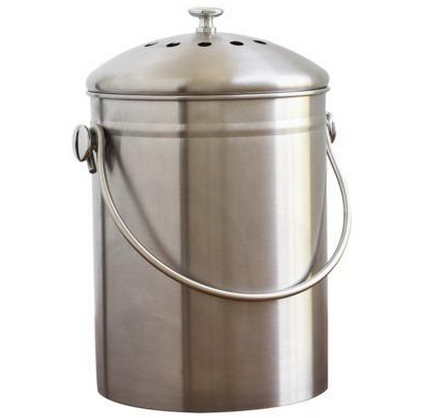
You see that shiny, confidence-inspiring, metallic compost can pictured at the top of this blog?  It looks great, right?  Fits in on anyone’s kitchen counter.  Looks clean, sanitary, sturdy.  Not exactly a shiny Tesla, but surely as iconic a symbol of its owner’s intention to save the planet.  Well, Teslas, it turns out, will spontaneously combust from time-to-time.  And that cute little compost can packed to the gills with food scraps can be equally evil.  No good deed goes unpunished, apparently.  Probably serves us right for being so self-righteous about saving the planet.  But I digress.

Emptying the compost can in our kitchen is perhaps the least-desirable household chore around here.  The kids pretend it’s not there.  My wife pretends it’s not there.  I use the thing religiously, each tossed-in coffee filter, eggshell or garlic skin making me feel like a really good person.  Look at me, I’m saving the planet!

I might as well be stuffing gun powder, wadding, and a cannon ball into a cannon.  Jam that stuff in there until nothing else could possibly fit.  Then jam some more stuff in there.

I don’t usually bring the contents of the compost can down to the green Recology bin in our garage until I absolutely have to.  I know what’s been stuffed in there over the past few days.  Or weeks.  A couple fruit flies spring free when the can’s top is lifted?  Not quite ready yet.  The compostable plastic-ish bag has fallen down on one edge, the victim of over-stuffing?  Reach down and pull it up a bit, like a reluctant dress sock with its elasticity long gone.  That sucker is good for at least a couple more days.

But pull off the lid and spy what appears to be a chicken bone dressed like Santa Clause?  Yep, it’s time.  Particularly if you can’t recall even making chicken for dinner in the last couple weeks.  And especially since you’ve read a bit about toxic spores, mold and such.  It’s definitely go time.

If you haven’t waited as long as I do, the process of transporting your little green bag of righteousness from your kitchen down the stairs to the large green bin of righteousness in your garage might go swimmingly.  Maybe you’re whistling or even humming while you are saving the planet.

But remember that I have gone over the composting handle bars.  There is no whistling or humming or thoughts of planet-saving when you’re in mid-air and turning a flip over your front wheel (to stretch the metaphor a bit further).

A week or so after a little Fourth of July get-together (involving the aforementioned, bearded Santa Clause chicken bones), I had my composting moment.

The cute little green bag burst, evidently pulling one “G” too many as I rounded the corner halfway down the garage stairs.  The thing exploded like a bomb, spewing stuff that no longer resembled anything I recognized as ever buying or cooking or serving to anyone in our house.  It looked like a blood-spattered crime scene in Dexter.   The sheer volume of the contents, splashed on the wall, stuck between the railing and the wall, scattered and oozy all over the carpeted stairs, it was staggering.  Almost too much to take.  I’m a little light-headed and panicky just thinking about it.

Expecting my wife to be home at any minute, I sprang into action; Harvey Keitel’s “the Wolf” in Pulp Fiction.  Just like that. Efficient.  Precise.  All business.  I managed to clean it all up, timely, and no one would have been the wiser had I not decided later to tell the story at the dinner table.

I was proud of myself, self-satisfied, clearly embracing this composting thing, despite having now seen its ugly underbelly.  Saving the planet.

Then it dawned on me that in my cleaning, I had deployed about a dozen bottles and canisters of completely toxic liquids, powders, and gels.  I threw everything I had at the crime scene.  Plastic bags to contain the vile stuff, bleach-soaked wipes removing the final traces of the explosion.  And all of it was deposited in the shameful, black trash bin.

I tried to console myself.  It was the best effort I could muster in the moment, so consumed with all the dry heaving, swearing and sweating.

Still, I had probably undone a year’s worth of planet-saving composting and recycling activities with those 15 ill-conceived minutes of toxic remediation in my garage stairwell.  Oh, if Lulu could see me now.

So like I said, there are two types of composters, and your time is coming….

Thanks for reading.

Overextended

This time I may have gone too far.

Email authors who could once be counted on for “C’est la vie” notes of support now verge on vitriol. The iconic “no worries” response is a thing of the past, apparently. I cringe, nowadays, when the auto-preview beneath the subject line populates with words that will bring a pit to my stomach. Yet another disappointee.

I need one of those big McDonald’s signs — “Over 300,000 People Disappointed!” instead of cheeseburgers served.

When it comes to my kids, I am a firm believer in holding doors open for them as long as humanly possible, until they are able to choose the doors to keep open themselves. I think my job is to give them options, to preserve their opportunities.

I am using every hand, elbow, foot, knee and chin to keep the doors from slamming shut. Sometimes I have to throw one open wide, pulling it with everything I have, then turning open another before the first swings shut again. Sometimes I am running down the hall at a full sprint, yanking on door knobs, shirt tails billowing, like some overdone dream sequence.

This seems most apparent when it comes to the sports my kids play. My 8 year-old Everett is just winding up his soccer and basketball seasons. I coached the latter, as I always have. But this past season I was physically present for perhaps only half of his games and practices. I’m not sure that made for a fair outcome for Everett, for the other players, or for our other coach.

I felt good about making it to their last practice last night. Managing to run a scrimmage and a few drills that maybe showed some objective improvement from the season’s beginning. There were quite a few smiles on the court, even.

Of course, in order to harvest those 8 year-old smiles with missing teeth, I had to short-change my older son.

Max is playing on a travel baseball team based in Marin County, across the Golden Gate Bridge from our home in San Francisco. The team practices three times a week. This frequency is actually new to our family. And I have heard of far worse schedules. Still, I haven’t quite mastered the art of being in two places at once. So I had to cobble together: A different school bus route than Max has ever taken in 8 years. A pickup at an unfamiliar bus stop in Marin. By a babysitter Max had never met before (nor had I). Who works with a (very generous, thankfully) family from Max’s new baseball team whom we barely know, and vice versa. A pre-game play date with said family’s son, one of the players on Max’s new team.

This all starts to feel like a convoluted game of Clue. The plan worked out fine, if fine is physically delivering Max to the appropriate field at the appointed time. And allowing me to coach Ev’s final YMCA basketball practice. Maybe the last such practice I will ever coach for Everett, since my basketball coaching bona fides are extremely thin.

And of course, Max had to miss his Little League practice that was being held across San Francisco Bay at the same time as he was running around on wet turf in Kentfield. His Little League coach (I am one of the assistant coaches) was understandably irked by Max’s absence. So I managed to disappoint Max and his coach with one fell swoop. Probably disappointed Everett, too, who complained that he got fouled a lot during his scrimmage and why didn’t I make the offending player cut it out.

My wife Hilary returned home that evening from an overnight work retreat. Typically I handle getting dinner ready for everyone. I’ve learned to relish this, turning myself into a decent cook over the years rather than viewing this as an unwelcome chore. But last night, given that Max’s baseball practice runs late, Hilary and Everett resorted to eating leftover pizza and birthday cake. The leftover pizza and birthday cake that we had served at Everett’s birthday party on Saturday.

That could have been a nice, uplifting point to end on. Save for the fact that Everett’s actual birthday was on December 6th. Saturday was March 1st. Three months later.

So like I said: Overextended.

Thanks for reading.

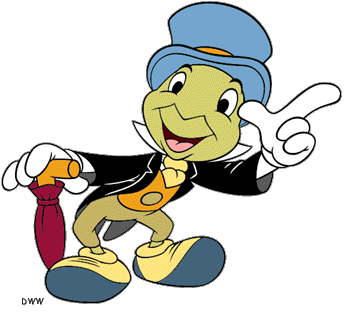
I Killed Jiminy.

Image


Well, technically, I didn’t kill him.  And technically, he wasn’t known as “Jiminy” at the crime scene.  He ran by the handle, “Chapulines,” or rather, he was one of the Chapulines.  And truth be told, I can’t really be sure that the victim was, indeed, actually Jiminy Chapuline.  It could have been just about any Chapuline that met his or her maker last night. I don’t know that I or anyone else can distinguish one Chapuline from any other Chapuline.  They all look the same.  Sorry, Diego.  Lo Siento. 

While I didn’t kill Jiminy, I did eat him.  He was already dead when I popped him into my mouth, his head squeezing out some sort of bitter juice in one final act of defiance, protest.  

It’s been awhile since I practiced criminal law, but I believe my actions make me an “accessory” to Jiminy’s undoing:  

An accessory is a person who assists in the commission of a crime, but who does not actually participate in the commission of the crime as a joint principal.  

Uh-oh, this sounds like I may be in trouble. 

Moroever,  an accessory must generally have knowledge that a crime is being, or will be committed. 

Well, I did see “Esquites with “Chapulines” on the menu.  And although I took a ton of Spanish in high school and at Duke, I honestly don’t recall every learning “cricket” in Spanish.  And I certainly never conjugated any verbs, ever, regarding which a cricket was the hapless victim.  So I have some wiggle room there.  

A person with such knowledge may become an accessory by helping or encouraging the criminal in some way, or simply by failing to report the crime to proper authority. 

Yeah, this is definitely not looking good for me.  There did come a time (The Lemonade Chronicles‘ first post, anyone?) when Jiminy and his jumbled ramekin of forelegs, midlegs, hind legs, and chewing mouthparts all akimbo, was set down at the center of our table.  At that moment, it’s true, I did not shoot to my feet, table legs humming across the wood floor with a loud rub, and scream, “Take that away!  I will not be a party to this!”  Nor did I yell, “Call 911, someone has been murdered up in this piece!”  

I will reserve the option of “reporting the crime to the proper authorities” once I have finished with this blog post.  I once dropped a dime on an axe-wielding Soul Train dancer.  I am not afraid to drop another on the ambitious–but morally unhinged–restauranteurs at La Urbana.  

This blog post and its self-destructive admissions will not look good to the jury.  Nor will the fact that I just referred to the blog post, the jury, the admissions, within the blog post.  Damnit, I just did it again.  Walk…away…from…the…keyboard. 

It gets worse.  The assistance to the criminal may be of any type, including emotional or financial assistance as well as physical assistance or concealment.

There is no getting around this one.  I did indeed contribute to our portion of the check.  I did not say, “We will gladly contribute to our half of this bill, subtracting the price of the murdered Gryllus Pennsylvanicus, regarding which we will not provide financial assistance.”  My wan smiles at the friendly waitress, who repeatedly checked in with our table to see how we were holding up after the Chapulines?  That could be interpreted as emotional assistance.  And as if all that weren’t enough, by chewing up and swallowing poor Jiminy, I’m fairly sure we can check off the “physical assistance or concealment” boxes.  

I’m done for.  No reasonable jury in its right mind could possibly ignore the overwhelming weight of this evidence against me.  My children will be left fatherless.  Motherless, probably, since my wife Hilary was right there with me the whole time, and I’m pretty sure she tasted at least one piece of Jiminy’s thorax.  I’m not throwing her under the bus, mind you, but I am open to turning State’s evidence for a more favorable sentence.  Desperate times call for desperate measures.  Every Chapuline for him or herself.  I mean, this is bad

I hope they have WordPress at San Quentin. 

Thanks for reading.