personal-training

EAT REAL FOOD. THE REST IS DETAILS.

I wore a continuous glucose monitor on the back of my arm, more or less continuously, for nearly three years.

Thirty-three months. 262,000 glucose readings. Every meal, every workout, every stressful Zoom call, every late night, every coffee — all of it tracked in real time by a sensor the size of a quarter reading my blood chemistry every few minutes. I ranked 187 foods by their glucose spike impact on my own metabolism. I found that summer on Cape Cod did measurably better things to my metabolic health than winter in San Francisco (96 mg/dL average vs. 101). I learned which supplements spiked my glucose, which ones didn’t, and which breakfast sent my blood sugar into a slow grind that didn’t resolve until noon.

I am telling you this not to brag about my commitment to data, but because the single most important thing my CGM taught me has nothing to do with data.

It is four words.

Eat real f*cking food.

That’s the Nutrition pillar of the Slowfit Method®. Four words. Everything else — the macros, the timing, the supplements, the fasting windows, the protein targets — is built on top of that foundation. If you get the foundation wrong, none of the optimization matters.

Foghorn Fitness is a reader-supported publication. To receive new posts and support my work, consider becoming a free or paid subscriber on Substack.

The book you need to read right now

Dr. Chris van Tulleken is a British physician, BBC journalist, and infectious disease researcher at University College London. For his book Ultra-Processed People: Why We Can’t Stop Eating Food That Isn’t Food, he spent a month eating 80 percent ultra-processed food while scientists monitored everything that happened to his body and brain.

He gained weight. His appetite regulation broke down. His gut microbiome degraded. His mood deteriorated. His desire for the UPF foods increased even as they made him feel worse — a textbook addiction response.

Then he stopped. And everything reversed.

Van Tulleken’s argument is not that ultra-processed food is unhealthy in the way that, say, too much salt is unhealthy. His argument is that UPF is not food. It is an industrially manufactured substance, engineered from cheap commodity inputs, designed in laboratories to override the satiety signals that evolution built into us over millions of years. The goal is not to nourish you. The goal is to make you eat more of it.

What is UPF? The working definition — the NOVA classification system — is not about calories or fat or sugar per se. It is about degree of industrial processing. If it contains ingredients you would not find in a home kitchen, if it has been assembled from components extracted from other foods, if its texture and flavor were designed to maximize palatability and minimize fullness — it is ultra-processed. This covers roughly 60 percent of the American diet. It covers most of what is in the middle aisles of your grocery store. It covers a lot of what you think of as “healthy” options.

Ultra-Processed People is the most important food book I have read since Robert Lustig’s Metabolical. It belongs at the top of your list. And the news is not all grim: Van Tulleken is not asking you to be perfect. He is asking you to understand what you are eating. Because once you understand it, the choices get easier.

The Lustig framework: it’s not the calories

Dr. Robert Lustig is a neuroendocrinologist at UCSF who has spent decades studying the metabolic effects of sugar and ultra-processed food. His book Metabolical makes the case that the chronic disease epidemic — obesity, type 2 diabetes, heart disease, cancer, Alzheimer’s — is not the result of personal failure or lack of willpower. It is the predictable result of an industrialized food supply that has been systematically engineered to maximize profit at the expense of metabolic health.

The core Lustig insight, summarized: sugar, and specifically fructose, drives insulin resistance and liver dysfunction in ways that do not show up in simple calorie counts. A calorie of fructose is not a calorie of glucose is not a calorie of fat. The “a calorie is a calorie” framework that dominated dietary science for fifty years was wrong, and it was convenient for the food industry for it to be wrong.

What to do about it: reduce added sugar, read ingredient labels, and default to foods that were not manufactured in a facility. The rule I use with every athlete I coach: if your great-grandparents would recognize it as food, it probably is.

You lose weight in the kitchen, not the gym

Herman Pontzer is a Duke evolutionary anthropologist who has spent his career studying human metabolism across cultures and activity levels. His research produced a finding that shocked the fitness world: the Hadza hunter-gatherers of Tanzania, who walk eight to ten miles a day hunting and foraging, burn roughly the same number of total calories as sedentary Western office workers.

The body adapts. Exercise is not primarily a weight management tool. It is a metabolic health tool, a cardiovascular tool, a bone density tool, a mental health tool, a longevity tool — but it is not the way to outrun a bad diet. You cannot out-train poor nutrition. The research is definitive on this.

The implication is not that exercise doesn’t matter. It matters enormously, for all the reasons above. The implication is that if your goal includes body composition, food is the primary lever. Exercise is the multiplier.

The protein argument you need to hear

Dr. Gabrielle Lyon’s Forever Strong makes the case that the medical establishment has been asking the wrong question. The focus has been on fighting fat. The real lever is building muscle.

Muscle is not just the thing that makes you look good at the beach. It is the body’s largest endocrine organ, the primary site of glucose disposal, the tissue most responsible for metabolic health and aging trajectory. Sarcopenia — the loss of muscle mass with age — is a more powerful predictor of mortality than obesity. And the solution is resistance training plus adequate protein.

Lyon’s prescription: one gram of protein per pound of lean body mass per day, minimum. This is higher than conventional recommendations and significantly higher than most people are actually consuming. She also makes the case for protein timing — prioritizing protein at breakfast rather than backloading it at dinner, and hitting a post-training protein window within 45 minutes of finishing a session.

The Momentous protein I use with athletes (code: FOGHORN) is NSF Certified for Sport and among the most rigorously tested on the market. If you are not hitting your protein targets from whole food sources, a quality protein supplement is not a crutch — it is a tool.

What 33 months of CGM data actually showed me

After 33 months of continuous glucose monitoring, here is what my own data showed me.

The foods with the highest and most consistent glucose spikes were exactly what you would expect: refined carbohydrates, sugary drinks, white rice, most bread, processed snacks. The foods with the lowest impact: vegetables, proteins, healthy fats, legumes.

What surprised me: how much stress spiked my glucose independent of food. A difficult conversation. A contentious Zoom call. A piece of bad news. These produced glucose responses nearly indistinguishable from a modest meal — without a single bite of food. The connection between the stress response and metabolic health is real and measurable.

What the data confirmed: 97.6 percent of my readings were in the healthy range (70-140 mg/dL). My mean glucose across the entire dataset was 99.7 mg/dL. I attribute this primarily to three things: real food as the foundation, consistent exercise, and — after taking a hard look at my relationship with it — no alcohol.

The alcohol honest conversation

Alcohol is part of the Nutrition pillar in the Slowfit Method®, and I am not going to soft-pedal it.

I stopped drinking nearly four years ago. Not because I had a problem by conventional definitions. Because the data was unambiguous — alcohol suppressed my REM sleep, elevated my resting heart rate, degraded my recovery scores, and spiked my cortisol in ways that took 48 hours to fully resolve. A drink or two on a Friday night was affecting my Tuesday training.

The U.S. Surgeon General issued an advisory in January 2025 declaring alcohol the third leading preventable cause of cancer in the United States, calling for updated warning labels. This came after decades of research suggesting a “safe” level of consumption. The current scientific consensus is that there is no safe level when it comes to cancer risk specifically.

I am not here to tell you how to live your life. I am here to be honest with you about what the research shows, and what I have experienced firsthand. If you are working on performance, recovery, sleep, or body composition, alcohol is working against all of them. That is just the truth.

Practical takeaways

Start with real food. If it grew somewhere or had a mother, it is probably food. If it was designed by a bunch of scientists and assembled in a factory from industrial inputs, it is probably not. This is not a complete nutrition system. It is a foundation. Build on it from there.

Read the ingredient list. Not the nutrition facts label — the ingredient list. If it contains more than five ingredients, or ingredients you cannot pronounce, think twice. Van Tulleken’s rule: if your great-great-grandmother would not recognize it as food, it probably is not.

Hit your protein target. Bodyweight in grams, minimum. Prioritize it at breakfast. Do not skip the post-training window.

Consider a CGM. Even a month of continuous glucose monitoring will tell you more about how your body responds to specific foods than any diet book. Levels Health is the platform I used for nearly three years. The data is genuinely eye-opening and I’d recommend it to any athlete serious about metabolic health.

Reduce added sugar. Specifically fructose in processed form — not fruit, not whole food sources. The ingredient list will tell you where it is hiding. High-fructose corn syrup, cane sugar, dextrose, maltose — there are 60-plus names for added sugar on labels.

Get honest about alcohol. You do not have to quit. But look at your Whoop data on nights you drink versus nights you do not and decide for yourself what the data is telling you. Or maybe read the alcohol post I shared awhile back; here ‘tis.

The Slowfit Method® app puts Coach Keir AI in your pocket — trained on all ten pillars including this one. Ask it anything about your nutrition, what to eat before training, how to manage glucose, what ultra-processed food is doing to your body, or how to hit your protein targets. One hundred people have already downloaded this app, and I’ve got nine 5-star reviews on the App Store. Check it out!

GET THE APP

I’ve added an easy way to book a free 30-minute introductory call with me to learn more about the Slowfit Method® and/or my AI Coach app, to discuss your training goals, or to explore what a private coaching relationship might look like. No pressure, no pitch — just a conversation.

BOOK HERE

Stick around.

Best,

Keir

Keir J. Beadling is a human performance coach, founder of Foghorn Fitness, and creator of the Slowfit Method®. He coaches athletes and everyday humans in San Francisco and worldwide. More information is available at foghornfitness.com.

THE COACH IS ON THE ROAD. THE APP IS IN THE GYM, OR THE OFFICE, OR THE STADIUM, OR….

I am somewhere between Salt Lake City and Omaha, with my Golden Retriever pup Ellie in her crate in the back with approximately 2,000 miles still ahead of us.

I’m behind the wheel for 7-10 hours a day. So the real Coach Keir is unavailable this week. He is driving, hydrating, eating cans of tuna and soup (yep, this is a thing with me), and listening to audiobooks about ultra-processed food (also a thing with me) while Ellie sleeps soundly in between pit stops (thankfully, this is a thing with her).

The AI Coach Keir, however, has not taken a single day off.

When I have a moment to check in on the app’s backend, this week I’ve been watching athletes I normally train with in person open The Slowfit Method® app, describe whatever equipment they have in front of them, and get complete, detailed, coaching-cued workouts back in seconds. No appointment. No Zoom link. No waiting for me to get off the highway.

Here’s what that looks like in practice.

Foghorn Fitness is a reader-supported publication. To receive new posts and support my work, consider becoming a free or paid subscriber.

Bob was at a track in San Francisco with stadium steps and a jump rope.

He asked for a 30-minute circuit with some push-ups or burpees. This is what Coach Keir AI gave him:

Warm-up (5 minutes): 2 minutes easy jump rope, World’s Greatest Stretch x5 per side, Hip 90/90 for 60 seconds, thoracic rotation x5 per side, leg swings front/back and side to side x10 each.

The circuit (20 minutes, 4 rounds, 60-90 seconds rest between rounds): Jump rope 60 seconds at moderate pace, stadium steps — run or power-walk up, walk down (one full trip), push-ups 10-15 reps full range chest to ground, burpees 5 reps quality over speed with full extension at the top, stadium steps — second trip up, walk down.

A legitimate Foghorn workout. Stadium steps, bodyweight, jump rope. No gym required.

Chris had a jump rope and a 30lb sandbell.

He asked for a HIIT workout. Coach Keir AI named it the Foghorn HIIT — Rope and Sandbell and built him this:

4 rounds, approximately 30 minutes, 60 seconds rest between rounds.

Jump rope for 60 seconds, sandbell slam for 10 reps, jump rope for 45 seconds, sandbell clean and press for 8 reps, jump rope for 30 seconds, sandbell rotational lunge for 6 reps each side.

The coaching cues were specific: for the sandbell slam, drive it down from overhead with the whole body — hinge, load the hips, reach to the sky, then throw it at the ground. For the clean and press, it is one fluid movement, not three separate ones. For the rotational lunge, step into it, rotate the sandbell across the lead knee at the bottom — Weck Method rotational power, head over foot, spiral through the spine.

The science note at the end cited Dr. Martin Gibala’s research at McMaster showing that short interval sessions match or exceed hours of moderate cardio for VO2 max and metabolic function. Then it linked his book.

Chris came back and asked for more.

This time: TRX, sandbell, and jump rope together. Coach Keir AI called it the Foghorn Full-Body Athlete and built a 40-minute, 4-round session.

Warm-up: jump rope 2 minutes easy rhythm, TRX hip hinge x10, TRX chest stretch 30 seconds each side, sandbell halo x8 each direction.

The circuit: jump rope double time for 60 seconds, TRX atomic push-up for 8 reps (full push-up, then drive both knees to chest simultaneously at the top — hips level, no piking), sandbell rotational slam for 10 reps (load the hip on one side, rotate through the torso, slam at a diagonal, alternate sides — pure rotational power), TRX suspended lunge for 8 each leg (rear foot in the cradle, front foot planted, sink straight down — these will humble you fast at any fitness level), sandbell clean and press for 8 reps, TRX row for 12 reps (body at 45 degrees or lower, pull elbows past ribs, squeeze scapulae at the top, slow the eccentric on the way down — that’s where the gains live), jump rope single leg alternating for 30 seconds each leg (balance and coordination challenge as much as cardio — if you lose it, reset and go again, no ego), sandbell lateral lunge and reach for 6 each side (step wide, sit into that hip, reach the sandbell toward the outside of the foot at the bottom — loaded hip mobility pattern, perfect for longevity goals).

Finisher after round 4: sandbell farmer carry 2×40 steps, jump rope 90 seconds your choice of tempo, TRX plank hold 60 seconds.

Recovery note from Coach Keir AI: after a session like this, the lymphatic system needs to move that metabolic waste out. Don’t just collapse on the couch — take a 10-minute walk, get some elevation in the legs, and hydrate. That’s where the adaptation happens.

Brought a Smile to My Face.

This is the app doing exactly what it was built to do. Bob and Chris train with me regularly in San Francisco. This week, while I’m in a car somewhere in the Mountain West, they are getting complete Foghorn-style sessions with full coaching cues, exercise science citations, and recovery protocols — built specifically for the equipment they have in front of them, in real time.

The free tier gives you ten exchanges with Coach Keir AI. Start there. Ask it what to do with the equipment you have. See what comes back. There are also a handful of written and video-on-demand workouts already loaded up in the app; you can run those if you’re feeling lucky. But remember, this is not just something for heavy-sweating gym rats (and no, I’m not suggesting that Bob and Chris are heavy-sweating gym rats). If you want to learn how to breathe better, eat better, sleep better, manage stress better, etc.—The app and I are here for you. Even if one of us is gripping a steering wheel non-stop for the next week.

One more thing: want to talk to the real Coach Keir?

This is new. I’ve added an easy way to book a free 30-minute introductory call with me to learn more about the Slowfit Method® and/or my AI Coach app, to discuss your training goals, or to explore what a private coaching relationship might look like. No pressure, no pitch — just a conversation.

BOOK HERE

One more pitch for the app! The Slowfit Method® app puts Coach Keir AI in your pocket — trained on all ten pillars including Movement and Strength. One hundred people have already downloaded this app, and I’ve got nine 5-star reviews on the App Store. Check it out! Slowfit Paid is $29.99 a month — a dollar a day — and gives you unlimited coaching chat conversations, full Vault access, and a growing library of on-demand workout videos.

GET THE APP

Stick around.

Best,

Keir

Keir J. Beadling is a human performance coach, founder of Foghorn Fitness, and creator of the Slowfit Method®. He coaches athletes and everyday humans in San Francisco and worldwide. More information is available at foghornfitness.com.

YOU TAKE 20,000 BREATHS A DAY. HERE’S WHY MOST OF THEM ARE WORKING AGAINST YOU.
At the end of the last post in this series — the Mindset pillar — I teased what was coming next.

Breathing. Specifically, why the way you breathe right now — most likely through your mouth, shallowly, chaotically — is undermining your performance, your sleep, and your stress response.

That was not hyperbole.

You take roughly 20,000 breaths a day. It is the only autonomic function you can also consciously control — the hinge point between your voluntary and involuntary nervous systems. And for most people reading this, the vast majority of those 20,000 breaths are making things worse. Not by a little. By a lot.

Let’s talk about why, and what to do about it.

James Nestor changed how I think about this

I referenced James Nestor in the walking post — noting that what he did for breathing, Conley and McDowell did for walking. Let me back up and actually give him his due here, because his book Breath: The New Science of a Lost Art is the text that cracked this topic open for me and for a lot of people.

Nestor spent years reporting on breathing, including blocking one nostril and spending ten days breathing exclusively through his mouth while scientists monitored everything that happened. Blood pressure went up. Snoring started. Sleep deteriorated. Cognitive function declined. Athletic performance dropped.

Then he switched to nasal-only breathing for ten days. Everything reversed.

His core finding: humans a long time ago breathed correctly. We have systematically unlearned how. The fossil record shows it — ancient skulls have wide jaws, spacious airways, straight teeth. Modern skulls, starting roughly with the industrial revolution and accelerating sharply with the rise of processed food and sedentary indoor life, show narrowed jaws, crowded teeth, reduced airway diameter, and the structural consequences of a species that has stopped chewing hard food and started breathing through its mouth.

This is not a minor lifestyle quibble. Nestor’s argument is that dysfunctional breathing is at the root of conditions ranging from anxiety and poor sleep to cardiovascular disease and immune dysfunction. And the fix — at its most fundamental — is embarrassingly simple: close your mouth.

Patrick McKeown on The Ready State

If Nestor is the journalist who broke the story, Patrick McKeown is the scientist who built the clinical framework around it.

McKeown is the founder of the Buteyko Clinic, author of The Oxygen Advantage, and one of the world’s most rigorous researchers on functional breathing. He recently appeared on The Ready State podcast with Kelly and Juliet Starrett — and given that Kelly Starrett is the person I credit for transforming how I think about mobility, movement, and physical preparation, this was a conversation I paid close attention to.

The key ideas from that episode:

Most people are chronically over-breathing. This sounds counterintuitive — we tend to think more breath equals more oxygen. But breathing too much actually depletes CO2, which is not just a waste gas. CO2 is the signal that tells your red blood cells to release oxygen to your tissues. When you over-breathe and drive down CO2, your body actually delivers less oxygen to where it needs to go, despite you breathing more. Paradox. A real one.

The BOLT score is your breathing baseline. BOLT stands for Body Oxygen Level Test. Take a normal breath in through your nose, exhale normally, then pinch your nose and time how long it takes before you feel the first urge to breathe. Not the maximum you can hold — just the first urge. A score under 20 seconds indicates dysfunctional breathing. Elite endurance athletes typically score 40 seconds or more. Most sedentary adults score 10 to 15 seconds. This one number tells you a lot about your CO2 tolerance, your anxiety baseline, and your recovery capacity.

McKeown also covers why women experience breathing and sleep differently than men — particularly around menopause — and why many sleep disorders in women may be going undiagnosed because sleep studies were historically designed around male breathing patterns. Example number 5,345 of how women are not just small men.

Mouth breathing in kids is a hidden developmental crisis. Mouth breathing in children has been proven to cause poor academic performance, craniofacial deformities, dental problems, and behavioral issues. If you have kids, this episode is worth paying very close attention to.

How to Measure Your CO2 Tolerance: The CO2 Exhale Test

Jesse Coomer’s The Language of Breath offers a complementary test to the BOLT score — one I’ve found particularly useful because it measures a different dimension of CO2 tolerance. This protocol was originally developed by elite fitness trainer Brian Mackenzie. It’s the one with which Foghorn athletes are the most familiar.

Where the BOLT score measures how long you can go before the urge to breathe strikes, the CO2 Exhale Test measures how long and slowly you can exhale — which reflects your nervous system’s relationship with CO2 and your actual breathing control.

Wanna give it a shot right now? Before taking the test, breathe normally. Don’t practice or mimic the test first; just breathe naturally. You will need a stopwatch.

Step 1: Take a deep breath through your nose and relax it out to neutral lungs.

Step 2: Wait until you feel the urge to breathe, then take another deep breath and relax it out to neutral lungs.

Step 3: Wait until you feel the urge to breathe again, then take a deep and full breath through your nose.

Step 4: Begin the timer as you exhale through your nose for as long and as slowly as you can.

Stop the stopwatch when any of the following occur: you completely run out of air; you swallow; or there is any interruption in the airflow as you exhale.

Your time is your score.

Scores and their meaning:

0 to 20 seconds: Very poor CO2 tolerance. Retest the following day to confirm — many people score low when under significant stress or illness. Before working on CO2 tolerance techniques, get this score to at least 21. Cardiovascular exercise is one of the best ways to improve it naturally. Do not jump into advanced CO2 tolerance training at this stage; it will add stress rather than improve tolerance.

21 to 40 seconds: Average modern human. You can begin CO2 tolerance training. You have significant room for improvement. This is where most of my athletes start out.

41 to 60 seconds: Advanced. A healthy range. You generally have a relaxed and smooth breathing pattern and can slow your breathing down relatively easily after exertion.

61 to 80 seconds: Elite. Your natural breathing pattern is slow and smooth, you rarely breathe more than you need to, and you experience increased resilience against stressors.

80 seconds and above: Master. You have become very comfortable with CO2 and are highly resilient against stress. I have athletes who’ve been training with me for a few years—which means they’ve been training their breath with me for that long—who are bumping along towards two and a half minutes. Yep.

Take both tests — the BOLT and the CO2 Exhale Test — and you have a meaningful baseline picture of your breathing health. Most people are surprised by how low they score. That’s not a reason for discouragement. It’s a reason to train.

The Language of Breath: where conscious meets unconscious

I recently read Coomer’s The Language of Breath — endorsed by McKeown himself , by the way — and it has a framing I really like.

Coomer’s core argument is that breathing is the one function where the conscious and unconscious self meet. Your heart beats without you. Your digestion runs without you. Your immune system operates without you. But your breath does all of this automatically — and also responds instantly to your conscious direction. It’s the bridge.

He cites the research: 95 percent of brain activity is unconscious. Your senses are reporting approximately eleven million pieces of information at any given moment. You consciously process about forty. The rest — your heart rate, your posture, your emotional state, your stress response — is being handled by your unconscious self, constantly, relentlessly, using everything it knows about your history and your environment.

Your breath is continuously informing that system. When you mouth-breathe, shallowly, rapidly, your unconscious self interprets this as a threat signal. It doesn’t know you’re just sitting at a desk answering email. It knows your breathing looks like the pattern of someone in danger. And it responds accordingly.

Coomer’s framing: “Most of our troubles in the modern age come from a lack of awareness of these foundational relationships.” We have become, in his words, mind-body machine operators rather than whole beings. Breathing, done correctly, is how you start to close that gap.

Jaws: the structural problem underneath everything

No conversation about dysfunctional breathing is complete without talking about the jaw.

Sandra Kahn and Paul Ehrlich open the relevant chapter of Jaws: The Story of a Hidden Epidemic with a line that I love: “Our jaws are built for a Stone Age diet, but we’re living in a Big Mac environment.”

Sheee-it. Nailed it.

That single sentence explains a remarkable amount. Our jaws are built for a Stone Age diet — tough meats, fibrous tubers, nuts, fruits that required real chewing effort, hours of it daily. What we get instead is soft bread, yogurt, applesauce, processed food bolted down in minutes. Kahn and Ehrlich identify three core areas of cultural shift that have driven the modern jaw crisis: what we eat and how we eat it, slack jaw and prevailing oral posture, and indoor living and how we breathe. All three are interconnected. All three are getting worse.

The structural consequences are measurable and serious. The human jaw has been shrinking for roughly 300 years. The result is narrow palates, crowded teeth, reduced airway diameter, and a structural predisposition to mouth breathing, snoring, and sleep-disordered breathing. Children of parents who cut food into tiny pieces — out of fear of choking — miss out on the learning experience of how the tongue and muscles coordinate to maximize extraction of nutrients from a meal, and don’t get the muscle exercise needed for healthy jaw development.

Orthodontia fixes the cosmetic symptoms. It doesn’t fix the airway.

If you struggle to breathe through your nose, there may be a structural reason. Addressing it — through myofunctional therapy, palate expansion, or airway-focused dental work — may matter more than any breathing protocol. And chewing more — harder foods, longer duration, starting in childhood — is the lowest-cost, highest-impact intervention available.

In the meantime, work on proper oral posture—mouth closed, teeth lightly touching, tongue pressed up against the soft palate. Simple, right? Kids, too.

What the research is showing

The science on breathwork has matured significantly in recent years.

A meta-analysis of randomized controlled trials showed that breathwork interventions significantly reduced self-reported stress, anxiety, and depressive symptoms. Slow-paced breathing was particularly effective in promoting parasympathetic activity and increasing heart rate variability.

Even single sessions of as little as two minutes of slow breathing have been shown to increase HRV, suggesting breathwork is accessible, cost-effective, and immediately impactful.

A 2024 randomized controlled trial published in JAMA Open Network found that physicians who regularly practiced structured breathwork over two months experienced significant decreases in insomnia, stress, and anxiety.

For athletes, the data on nasal breathing during training is accumulating. McKeown’s Oxygen Advantage framework — training with nasal-only breathing during moderate-intensity work — has been shown to improve CO2 tolerance, increase VO2 efficiency, and reduce the ventilatory threshold. Kipchoge ran his sub-two-hour marathon with his mouth closed for most of it! Worth noting.

If you are using Whoop and your HRV is suppressed, your breathing habits during the day and during sleep may be a primary driver.

Practical takeaways

The good news: the interventions are free, require no equipment, and can begin immediately.

Take both tests. Do the BOLT score and the CO2 Exhale Test today. Write both numbers down. These are your baselines. Return to them in four weeks of nasal breathing practice and see what changes.

Tape your mouth at night. McKeown and Nestor both do it. Micropore medical tape across the lips encourages nasal breathing during sleep, reduces snoring, and improves sleep quality for many people within a few nights. Works for me.

Train nasal. During easy and moderate-intensity training — your Zone 2 work, your warm-up, your cool-down — breathe exclusively through your nose. If you can’t maintain nasal breathing at a given pace, slow down. Your pace will catch up to your breathing capacity over weeks of training.

Use the downregulation protocol before bed. Nasal breathing only, belly-led inhales, exhale twice as long as the inhale, 4-count in and 8-count out, three to five minutes minimum, thirty minutes before bed. This is your direct dial into the parasympathetic nervous system. Use it every night.

Practice box breathing for stress. Four counts in through the nose, four counts hold, four counts out through the nose, four counts hold. Four rounds. This is what military units use for acute stress regulation.

Chew. Hard foods, more often. Sugar-free xylitol gum. Tougher proteins. Raw vegetables. Your jaw is a use-it-or-lose-it structure — and relatively little chewing early in life can alter the development of your entire face, jaws, and airways.

Learn the Wim Hof Method for upregulation. And here’s one more big one, as every Foghorn athlete knows: Wim Hof Method upregulation breathing. Every training session I run – bootcamp, 1:1, Zoom – begins with a round of Wim Hof Method breathing. This is the other side of the breathwork coin. Where the downregulation protocol dials you down, WHM dials you up. It is a deliberate, controlled form of hyperventilation that primes your nervous system, floods your body with adrenaline, alkalizes your blood, and generates a state of heightened focus and physical readiness before you start moving. I’ve been using it as a warmup tool for years, and the science has been catching up fast. A 2024 systematic review in PLOS ONE found promising evidence for WHM’s effects on inflammatory response and exercise performance. A randomized controlled trial published in 2024 showed WHM practice reduced depressive symptoms and stress – with high-arousal WHM-style breathing specifically outperforming calming protocols for some individuals, challenging the assumption that breathwork should always be downregulatory. A 2023 study in Scientific Reports found that 15 days of WHM practice improved blood pressure, HRV, and subjective vitality.

The protocol: sit or lie down comfortably. Take 20 to 30 deep, powerful breaths – inhale fully through the nose or mouth, then let go without forcing the exhale. Keep a steady, rhythmic pace. After the final exhale, hold your breath with empty lungs for as long as comfortable – most people start at 60 seconds and build to two or three minutes over time. Then take one deep recovery breath, hold it for 10 to 15 seconds, and release. That’s one round. Do three to four rounds. You will feel tingling, lightheadedness, and a warmth spreading through your body – all normal, all physiological. Do not do this in water, while driving, or anywhere a loss of consciousness would be dangerous. When you finish, you are primed. Now go train. For the full method, Wim Hof’s book is the place to start: The Wim Hof Method.

Next up in this series: Nutrition. Specifically, why the most important dietary intervention most people could make costs nothing, requires no supplements, and is not a diet at all.

All ten pillars of the Slowfit Method® live here on Substack and at foghornfitness.com. Paid subscribers get deeper dives, workout programming, and the full resource library.

The Slowfit Method® app puts Coach Keir AI in your pocket — trained on all ten pillars including this one. Ask it anything about your breathing, your CO2 tolerance, your sleep, or your stress. One hundred people have already downloaded this app, and I’ve got nine 5-star views on the App Store. Check it out!

Get the app

And if you’re interested in a 1:1 private coaching relationship, you can book sessions at foghornfitness.com . You can even book a free intro discussion with me to learn more about how the Slowfit Method® could amp up your performance, health and happiness.

Stick around.

Best,

Keir

Keir J. Beadling is a human performance coach, founder of Foghorn Fitness, and creator of the Slowfit Method®. He coaches athletes and everyday humans in San Francisco and worldwide. More information is available at foghornfitness.com.

THE TEN-QUESTION RULE

The free tier of the Slowfit Method® app gives you ten exchanges with Coach Keir AI.

Ten.

When I tell people that, the first reaction is usually some version of: that’s not very many. And I get it. We live in an era of unlimited everything. Unlimited streaming, unlimited scroll, unlimited storage. Ten feels like a parking meter in a world where everything else is free parking forever.

But here’s what I’ve noticed in the coaching admin dashboard, watching real users move through the app: ten is plenty. More than plenty. For a lot of people, ten is exactly right.

Because the users who are getting the most out of the free tier aren’t treating their questions like chips at a casino. They’re treating them like wishes from a genie.

You’ve heard the rule. Three wishes. You don’t waste them on a baloney sandwich. You think carefully. You ask the question that actually matters. You are intentional (and you are now likely getting a sense for why I call this “Slowfit,” right? As in slow streets, slow food, slow parenting, etc.)

That’s what I’m watching people do.

Foghorn Fitness is a reader-supported publication. To receive new posts and support my work, consider becoming a free or paid subscriber.

KARI

Her question: “Give me a 10-minute mobility flow I can do anywhere.”

Coach Keir AI pointed her to Kelly Starrett’s morning mobility routine from The Ready State — a progression I’ve personally used before every single training session since 2021. Hip flexors, thoracic spine, shoulders, ankles. The full sequence. Plus a pointer to Built to Move for anyone who wants to understand the why behind the what.

Kari got a complete protocol rooted in the best mobility science I know. Then she closed the app and went to go do it.

That’s the whole point.

ALICIA

Her question: “Tell me about the Nutrition pillar of the Slowfit Method® and give me one action I can take today.”

Coach Keir AI gave her the real answer: four words. Eat real food. Then unpacked it — Herman Pontzer’s research on why you lose weight in the kitchen, not the gym. Dr. Robert Lustig’s case against ultra-processed food as the root of modern chronic disease. The CGM data I ran for nearly three years and what it actually showed me.

Her one action for the day: read every ingredient label on everything she ate. If it had more than five ingredients, or ingredients she couldn’t pronounce, put it back.

One question. One framework. One action. Done.

ANDY

His question: “What is the most important thing I can do tonight to improve my sleep?”

Coach Keir AI gave him a downregulation breathing protocol — nasal only, belly-led inhales, exhale twice as long as the inhale, 4-count in and 8-count out, body scan from head to toe, 3 to 5 minutes minimum, starting 30 minutes before bed. It’s not complicated. It’s a direct line into the parasympathetic nervous system. The science is about as solid as it gets.

Andy’s habit log already shows he’s been tracking sleep. He came in with a real question. He got a real answer. He didn’t need a follow-up. He needed to go to bed.

Here’s what strikes me about all three of these interactions—

None of them burned through their ten questions on things they could have Googled. None of them treated the AI coach like a toy to pass time. They showed up with a real question — something that had been sitting in the back of their mind or triggered by one of the app’s home screen prompts about the big behavioral levers — and they left with something they could use. Today. Tonight. Tomorrow morning.

Then they closed the app and went back to their lives.

This is the opposite of how almost every other app on your phone is designed to work. Social media doesn’t want you to get what you need and leave. It wants you to stay. It wants you confused, reactive, comparing, scrolling. The whole machine runs on unresolved attention.

The Slowfit Method® app is designed around a different premise: get in, get what you need, go do the thing.

The ten-question limit on the free tier isn’t a constraint I’m apologetic about. It’s a forcing function. It asks you to show up with intention. To think about what you actually want to know. To treat the coaching conversation like the valuable resource it is.

When the genie offers you three wishes, you don’t waste one of them asking what the time and temperature are.

Ask the question that matters. Get the answer you need. Go do the thing.

That’s Slowfit.

The Slowfit Method® app is free to download. Coach Keir AI, your personalized training framework, and access to all 10 Slowfit pillars are included in the free tier. If you want unlimited coaching conversations, full Vault access with 300+ curated books, podcasts, gear, and supplement recommendations organized by pillar, and a growing on-demand video library, that’s Slowfit Pro.

It’s $29.99 a month. A dollar a day.

And right now, I’m making an offer to the first two people who upgrade: a Foghorn Fitness t-shirt, on me. I’ll mail it to you personally. Brand new, high quality, and perfect for training — or just living in. To upgrade, open the app, go to Settings, and tap Change Plan. Takes about 30 seconds.

Get the app

Keir J. Beadling is a human performance coach, founder of Foghorn Fitness, and creator of the Slowfit Method®. He coaches athletes and everyday humans in San Francisco and worldwide. More information is available at foghornfitness.com.

See you out there!

Keir

How Seven Principles Changed the Way I Built My AI Coaching App

The Center for Humane Technology had a lot to do with it.

I’ve been following Tristan Harris and Aza Raskin at the Center for Humane Technology for years. If you’ve seen The Social Dilemma on Netflix, you know Tristan’s face and his argument: the tech companies that run our lives are not neutral platforms. They’re slot machines, engineered by very smart, very well-funded people to maximize one thing above all else. Not your health. Not your relationships. Not your sleep. Your time on device.

That argument is not new to regular Foghorn Fitness readers. I’ve written about it at length. The distraction pillars. The phone breakup series. The Johann Hari and Jonathan Haidt posts. I’ve been making the case for years that your smartphone is doing things to your attention, your sleep, your nervous system, and your relationships that you haven’t consented to and probably don’t fully understand.

And then I built an app.

Wait, what? 

I know. We’ve been over this. And a podcast episode I listened to yesterday clarified things for me in a way I hadn’t expected. CHT just released a new Your Undivided Attention episode in which Aza Raskin sits down with fellow CHT co-founder Randy Fernando to walk through their Seven Principles of Humane Technology. I want to take you through those principles — and then show you, specifically, how each one maps to the design decisions I made building the Slowfit Method® app.

Because this isn’t abstract. Every one of these principles shows up in the product.

First: What’s Actually Wrong With Most Tech

The episode opens with a clip from CHT’s very first podcast guest, cultural anthropologist Natasha Dow Schüll, who spent years studying casino design in Las Vegas. What she observed is the design logic behind modern slot machines: the goal is “time on device.” Everything is engineered to eliminate fatigue, minimize disruption, and keep you in the chair. Light doesn’t bounce at your eyes. Sound doesn’t jar your senses. The environment is calibrated to sustain your engagement indefinitely.

Raskin’s point: that’s exactly how your apps are designed. Not for your wellbeing. For time on device. Instagram, TikTok, YouTube, the news feed — different technologies, same broken ideology.

Raskin himself invented the infinite scroll, pre-social media. He watched it get weaponized against users and has spent the past decade trying to undo the damage. He estimates it wastes something on the order of 100,000 human lifetimes every week.

That’s the problem CHT’s seven principles are designed to solve. Here they are — and here’s how I applied each one.

Principle 1: Use a Complex Systems Lens

One of the big things that we miss a lot when we are dealing with technology is we don’t look at the whole system. We look at just one small piece of it and that means we don’t correctly understand what its effects are going to be and we don’t correctly understand how to fix the problems that we find. — Randy Fernando

The failure mode Fernando describes is optimizing for a single metric — engagement, time on site, daily active users — while ignoring what that metric does to everything else. YouTube optimized for watch time. The result was algorithmic extremism. You can’t see the damage from inside the single metric. You need to look at the whole system.

In the Slowfit Method® app, I deliberately refused to build around a single engagement metric. There are no daily active user dashboards driving product decisions. There are no A/B tests designed to squeeze more sessions out of users. The question I kept asking during development was not “how do we get people to come back?” It was: “what does a successful interaction actually look like?” The answer: the user got what they needed and went and did “the thing.” That’s the whole system I was trying to optimize for.

Principle 2: Protect the Systems We All Depend On

If you extract faster than something can regenerate, obviously that’s a problem. Technology is a huge exponentiator of that extraction process. — Randy Fernando

Fernando’s framework here is extraction vs. regeneration. Most tech extracts — attention, time, data, dopamine — faster than humans can regenerate. The result is depletion. Of attention spans. Of sleep. Of real-world relationships. Of the shared information environment we all depend on for democracy to function.

The Slowfit Method® is built around the opposite premise. Sleep, recovery, social connection, movement, mindfulness — every pillar is about replenishment, not extraction. I tried to build an app that reflects that. An hour on the app is an hour less of the things that regenerate you. So the app shouldn’t take an hour. It should take two minutes and send you back to the things that do.

Principle 3: Design for Genuine Thriving

A tool that’s designed for genuine human thriving will leave you stronger when you put it down than when you picked it up. — Aza Raskin

This is the principle most directly tied to the experience of using technology. Raskin puts it simply: when you put your phone down after an hour on it, do you feel better or worse? When you wake up the morning after a late-night scroll session, do you feel better or worse?

Fernando connects the anti-AI sentiment building in the culture to this principle’s absence. Students booing AI at commencement speeches. Parents pulling kids off platforms. Communities organizing against data centers. That resistance isn’t coming from people who’ve read ethics papers. It’s coming from people who can genuinely feel that something is wrong.

What they’re feeling, Fernando argues, is the absence of this principle. Technology built to extract attention, replace labor, and harvest data rather than to genuinely serve the humans using it.

When I designed the Coach Keir AI interface, I wrote this into the system prompt: the AI should never try to extend the conversation beyond what’s useful. It should give direct answers. It should end responses with a single action item. It should tell you to put the phone down. Literally. You saw the screenshot in an earlier post: “Your move: Phone face down across the room. Lights out. Start breathing.” That’s designing for genuine thriving.

Principle 4: Align Incentives with Human Wellbeing

The fourth principle is about business models. Most tech companies have a fundamental misalignment: they make money when you use the product more, not when you’re healthier, better rested, or more connected to the people in your actual life. That misalignment is structural. It’s not fixed by good intentions. It’s fixed by changing the incentive.

The Slowfit Method® app runs on a subscription model. I make money when people find enough value to pay for ongoing access to the Vault — 270+ books, podcasts, tools, and on-demand workouts — not when they spend more time banging around for hours in the chat interface. That changes what I’m actually optimizing for. I want the free Coach Keir AI interactions to be so useful and so direct that people think “this person’s deeper knowledge base is worth paying for.” Not “I can’t stop using this.”

Principle 5: Foster Autonomy and Agency

Inhumane tech exploits psychological vulnerabilities. Variable reward schedules. Social comparison. FOMO. The fear of missing out on what everyone else is seeing right now. These are not neutral design choices. They are deliberate mechanisms for hijacking your decision-making and substituting the algorithm’s agenda for your own.

I built the anti-version of this into every layer of the app. No infinite scroll. No push notifications designed to pull you back. No streak mechanics that make you feel bad for not opening the app three days in a row. No social comparison features. The Coach Keir AI is explicitly designed to be anti-sycophantic — it will tell you what you need to hear, not what you want to hear. Autonomy means you get accurate information and make your own decisions. That’s what I want the app to support.

Principle 6: Ensure Accountability and Transparency

This one is personal. When you open the Coach Keir AI, the first thing you see is a banner: “AI-generated responses. Coach Keir AI is not a licensed medical professional. Emergencies: 911. Mental health crisis: call/text 988.”

That’s not a legal disclaimer buried in the terms of service. That’s the first thing you see, every time, in the primary interface. Because transparency about what the technology is and isn’t matters. The AI is trained on my writing and my methodology. But it is not me. It is not a therapist. It is not a doctor. It is a tool. I wanted users to know that before they typed their first message.

I also published Substack posts about the app’s design philosophy before and again after I published anything about its features. One about why I built it to not be addictive. Another about the ethical decisions baked into the system prompt: the anti-sycophancy rule, the distress routing protocol, the nudge toward real human coaching. Accountability means making those decisions visible, not hiding them in the product.

Principle 7: Build for the Long Term

The final principle is the hardest one for most tech companies because the market actively punishes it. Fernando uses car safety as his example: the automakers weren’t excited about investing in safety until cultural pressure, regulation, and changed incentives forced them to. The same transformation needs to happen in tech.

I think about this principle in terms of the Slowfit Method® itself. The whole framework is built around the long game. Not the fastest result, the best result over time. Not maximum intensity, optimal sustainable load. Not the biggest Strain Score number on your Whoop this week, the best recovery over the next twenty years.

The app is an expression of that philosophy. I’m not trying to maximize short-term engagement metrics. I’m trying to build something that is genuinely useful to people over time. Something that, in a year, someone might say: that app didn’t try to take over my life. It helped me understand mine a little better. Actually helped me improve things. And then it got out of the way.

Why This Matters Right Now

I am not under any illusion that a single human performance coach bumping along towards 100 app downloads over two weeks in San Francisco is going to single-handedly reform the tech industry. That’s not the point.

The point is that the principles exist. They’re not idealistic. They’re not impractical. They’re a checklist that any builder of any product — at any scale — can apply. And I applied them. Imperfectly, with limited resources, in a space dominated by products that ignore all seven.

Raskin ended the episode with something that stuck with me. He said you know a system is humane when it is protecting the thing that it depends on. Ask yourself: has social media made democracy stronger or weaker? Has the infinite scroll made your attention stronger or weaker? Has the algorithm made your relationships stronger or weaker?

The answers are obvious.

Now, after spending a little time kicking the tires on my little app, ask: has the Slowfit Method® made my health stronger or weaker? Has Coach Keir AI made my sleep better or worse? Has this app left me more capable or less?

Those are the right questions. They’re the only questions, I’d say. I hope you’ll make a little bit of space in your life for this app. I promise it’ll help. 

And maybe go listen to the Your Undivided Attention episode. It’s 52 minutes and it’s worth every one of them.

Stick around.

Best,

Keir

P.S. The app is free to download. Coach Keir AI is available to all users. The full Vault unlocks with a paid subscription. Download here.

P.P.S. Want to work through any of this with a real human coach, as in, me? Book a session at foghornfitness.com.

P.P.P.S. Paid Substack subscribers get the deeper dives and the full resource library. Upgrade here.

P.P.P.P.S. All ten pillars of the Slowfit Method® at foghornfitness.com.

The App I Built Is the Opposite of Everything I’ve Been Warning You About

“This phone is the devil”

— a childhood friend, via text, this morning

He’s getting off Instagram. Can’t say I blame him.

I’ve spent years writing about your phone. Specifically, about what it’s doing to you. (And to me.)

In January 2024 I wrote about Johann Hari’s Stolen Focus and the trillions of dollars arrayed against your ability to pay attention. In February 2024 I went deeper on why it’s so hard to focus — the dopamine dependency, the slot-machine mechanics, the infinite scroll engineered to exploit our evolutionary hard-wiring. In October 2024 I wrote about Jonathan Haidt’s The Anxious Generation and what the smartphone has done to our kids. And before all of that, Cal Newport’s Digital Minimalism convinced me to deliberately downsize my iPhone use, strip the social media icons off my home screen, and mute the notifications pulling my attention toward that hunk of plastic and glass in my pocket.

The research is clear. Maggie Jackson, in Distracted, put it as starkly as anyone: with our attention scattered among the beeps and pings of a push-button world, we are cultivating a culture of distraction and detachment.

I didn’t just write about this stuff. I lived it. A while back I documented my own month-long attempt to break up with my iPhone — the rubber band around the phone, the grayscale screen mode, a Giants game where I didn’t look at a screen once (one of my prouder moments). The whole messy field report is in the Phone Breakup series if you want to go down that rabbit hole. The short version: it’s hard, it’s worth it, and I failed more than I succeeded. But I kept trying.

And then I went and built an app.

I know.

Here’s the Thing I Had to Reconcile

When I first started thinking seriously about building the Coach Keir AI app, I had a problem. Not a technical problem — that was my developer Alex’s department. Rather, I had to address a philosophical one.

I had spent years making the case that our smartphones are attention-harvesting machines designed by very smart, very well-funded people to keep us glued to screens as long as humanly possible. I had written about Anna Lembke’s Dopamine Nation and the way pleasure-seeking loops get forged into deep neural grooves. I had cited the Center for Humane Technology and Tristan Harris’ warnings about what engagement-maximizing technology is doing to human cognition. I had recommended Catherine Price’s How to Break Up with Your Phone to pretty much every athlete I coach.

And I was about to add another app to the App Store?

The only way I could do it in good conscience was to build the opposite of what everyone else was building.

So that’s what I did.

What “The Opposite” Actually Looks Like

No infinite scroll. No push notifications engineered to pull you back. No streaks. No engagement metrics. No algorithmic filler designed to keep your eyes on the screen.

The app gives you what you need and sends you back to your life. That’s the design spec. Use it as a springboard, not a slot machine. Remember Patagonia’s famous “Don’t Buy This Jacket” ad in The New York Times? Same energy. I want you to use this app. I also want you to use it for two minutes and then go to sleep.

Speaking of sleep.

Meet “Julie”

One of my longtime Foghorn athletes — I’ll call her Julie — has a bedtime habit that will be familiar to a lot of you.

She gets into bed at 10:30. She picks up her phone to “check one thing.” An hour later she’s still on Instagram, heart rate quietly elevated, nervous system humming, cortisol doing what cortisol does when you’ve been consuming a high-speed feed of other people’s highlight reels for 60 consecutive minutes. She falls asleep somewhere around midnight. Her Whoop recovery score the next morning is dismal. She’s groggy, short-tempered, and reaching for an extra cup of coffee by 9 a.m.

We’ve talked about this in our sessions. A lot. She knows the science. She’s read the posts I’ve sent her. She knows that the blue light from her phone suppresses melatonin, that the emotional arousal of social media keeps her sympathetic nervous system activated exactly when she needs to be downregulating, that the unpredictable reward schedule of Instagram is the same mechanism that keeps people at slot machines.

Knowing isn’t the same as doing.

So a couple weeks ago I told her to try something different. Instead of reaching for Instagram when she gets into bed, open the Coach Keir AI app and type in what she’s feeling.

Here’s exactly what Coach Keir said:

Julie, put the phone down right now. Instagram at 10:30pm is gasoline on the anxiety fire — the algorithm is literally designed to keep your nervous system activated. I know it feels like comfort but it’s the opposite.

Here’s your downregulation breathing protocol. Do this right now: Close your mouth. Keep it closed throughout. Start with a quick body scan from head to toe — wherever you find tension (jaw, shoulders, chest), let it dissolve on your exhales. Now breathe:

• 4 counts in through your nose, belly-led

• 8 counts out through your nose, slow and controlled

• No aggressive pauses, circular and gentle

• When your mind wanders to work anxiety, gently bring it back without judgment — no self-criticism, just return to the breath. The extended exhale is the physiological key — it directly activates your parasympathetic nervous system. Your body cannot stay in fight-or-flight with a long nasal exhale. This isn’t woo, it’s autonomic nervous system science. Do this for 5 minutes. Then finish with one big inhale all the way to the top, slight hold, then the longest possible nasal exhale you can sustain. That final exhale is your reset.

One more thing: If you want guided support for this, Headspace has excellent sleep meditations that pair perfectly with this protocol. It’s the only meditation app I use and endorse. Your move: Phone face down across the room. Lights out. Start breathing. You’ve got this Julie. Goodnight.

Two minutes to read that. Five minutes to do the breathing. She was asleep by 10:45. That’s not a miracle. That’s a tool.

The Irony Is Intentional

Yes, this requires using a phone to stop using a phone. I get it. That’s a real tension and I won’t pretend otherwise.

But here’s what I’d offer: the problem was never the device. It’s what the device is typically used for. Instagram, TikTok, and the news feed are engineered for maximum engagement. A breathing protocol is not. One is a slot machine. The other is a tool.

Catherine Price’s framework — ask yourself “What for? Why now? What else?” before you reach for your phone — is the right instinct. Most of the time, the answer to those three questions is damning. But occasionally the answer is: I need a downregulation protocol so I can sleep. And for that, a phone can actually help.

The Slowfit Method® has always been about intentional choices. Being deliberate about how and why we are living our lives, rather than just pouring more water into a glass that is already overflowing and hoping for the best. The app is the method in your pocket. Use it intentionally. For two minutes. Then put it down.

That’s the whole pitch.

Download My App

What “Julie” Said Last Week

“Honestly? I forget sometimes and I end up on Instagram anyway. But when I remember to open the app instead, I’m asleep in under 15 minutes. When I don’t, I’m awake until midnight and I hate myself a little.”

Not a case study. Not a controlled trial. Just a Foghorn athlete who found one thing that works slightly better than the thing that wasn’t working.

Which is more or less what the Slowfit Method® is for.

My buddy from childhood is getting off Instagram. Good for him.

The phone doesn’t have to be the devil. But it’s up to us to make sure it isn’t.

Stick around.

Best,

Keir

P.S. The app is free to download. Coach Keir AI is available to all users. The full Vault — 270+ books, podcasts, tools, and on-demand workouts — unlocks with a paid subscription. Download here.

P.P.S. Want to work on sleep, distraction, or any other pillar of the Slowfit Method® with a real human coach? That’s what the 1:1 work is for. Book a session at foghornfitness.com. I have availability. Hit that button.

Book a Session

P.P.P.S. Paid Substack subscribers get the deeper dives and the full resource library behind every pillar. Upgrade here.

P.P.P.P.S. The new Foghorn Fitness site just launched. All ten pillars, the full method, everything in one place. foghornfitness.com.

The Most Underrated Longevity Drug Costs Nothing and You Already Know How to Do It

A Foghorn Fitness / Slowfit Method® dispatch

Oops, I did it again. I went and disappeared for two more years from this here blog. Again. I promise not to do that again. My apologies. The original intent of The Lemonade Chronicles was as a sort of real-time journal of a reluctant stay-at-home dad as he approaches mid-life. Most of the “action” (if you can call it that) transpired more than 10 years ago. Everything leading up to my mid 40s, and something of an existential struggle.

Ten-plus years on, and things are waaaaaaay different.

My kids are in their 20s and miraculously, my wife and I seem to have done a reasonably good job with the boys, Max and Everett. I suppose that parenting never really ends, but the degree to which we exert control over their lives lessens every day. And I’m cool with that. Hilary is still the rock of our family, steadfast as always. We’ve had some losses, as is the case with life. Hilary’s parents. Aunts and uncles on both sides of the family. We lost our beloved Lab Wailea a couple years back. And time is taking its toll on people around us about whom we really care.

As for me? My own evolution, as a human being chasing the elusive bright side, has continued. Picked up pace, even, in the last 6 or 7 years. Ten years or so ago, I had a lot of questions. What is the meaning of life? How do I take care of myself and the people (and animals) that I love? Am I doing it right? These questions served as the impetus for creating another (and presumably my last) little company.

This is the human performance company called Foghorn Fitness.

As I think about it, this is the culmination of my life’s work. Everything I’ve learned to this point. And really, somehow I think I’ve managed to build a pretty robust vehicle to help guide folks (and myself) to a happier and healthier life. There’s even an app for it!

I’ve been writing a ton, just not on this platform. Everything is now over at Substack. That’s now the place to go for the good stuff, though I suspect I’ll continue spinning yarns here, as well. If you’ve followed me years ago, agitating about Alien Heads, dogs who eat money, and missing the school bus, I think you’ll find this latest chapter of mine of interest. I hope you will. When last we were acquainted, I had so many questions about life. Maybe you did too. Now I think I have the answers. Well, at least some of them. I hope you’ll join me and come along for the ride.

To that end, I’m going to jump right into it. Maybe a more apt image would be walk right into it. Because this post is about walking. Walking? Yep. Walking. Bear with me….

Because this is a thing you already know how to do — have known since you were about a year old — that is one of the most evidence-backed longevity interventions available to you, costs absolutely nothing, requires no equipment, no gym membership, no coach, and can be done anywhere on earth.

You are almost certainly not doing enough of it.

Walking. That’s it. That’s the whole revelation.

I know. Anticlimactic. But stay with me, because the research is genuinely surprising, and the running boom — I say this as someone who runs — has done a lot of damage to walking’s reputation that it doesn’t deserve.

WALKING IS THE SIXTH VITAL SIGN

Dr. Courtney Conley and Dr. Milica McDowell just published Walk: Rediscover the Most Natural Way to Boost Your Health and Longevity — One Step at a Time, and it is the book I’ve been waiting for on this topic. What James Nestor did for breathing, what Kelly and Juliet Starrett did for mobility, Conley and McDowell do for walking. Their central argument: walking is as important to your health and longevity as sleep and proper breathing. It is the sixth vital sign. And yet we’ve almost engineered it out of our lives.

The details are striking. Your walking speed can predict your overall health status and risk of early death. Your risk of falls and longevity can be measured by your foot health. And the number of daily optimal steps is not 10,000, it’s fewer. That last one will rearrange some people’s mental models. And hopefully rearrange people’s shoe closets. Enough with the foot coffins, folks.

BORN TO WALK—AND LIFT, SPRINT & PLAY

Mark Sisson’s Born to Walk makes the case most forcefully, and it’s worth spending a moment here because his full prescription maps almost exactly onto the Slowfit Method®.

Sisson’s argument isn’t just that running is overrated. It’s that we’ve misunderstood the entire architecture of human physical activity. He describes a movement pyramid built around four layers:

Low-level aerobic movement — walking — as the foundation. This is your Zone 2 base. Sustained, conversational-pace movement that builds mitochondrial density, improves insulin sensitivity, and develops your aerobic engine without the joint stress of running. Walking is Zone 2 for most people. The running boom convinced an entire generation that anything less than hard cardio didn’t count. That was wrong. Instead, most of us are running ourselves into the ground.

Strength training as the second layer. Not optional. Sisson is explicit: lifting heavy things is what signals the body to maintain muscle mass, protect bone density, and keep hormones functioning as you age. Same argument Attia, Luks, and Topol all make in the longevity books I covered last month. Muscle is the organ of longevity.

Sprinting and high-intensity work as the third layer, but sparingly. Short, hard efforts a couple of times a week. Not chronic cardio. Brief, intense, and followed by full recovery. This is what Foghorn’s HIIT sessions are built around.

Play as the fourth layer. Sisson is serious about this one. Unstructured physical activity, sports, martial arts, open water swimming, anything that involves moving your body in ways that aren’t predetermined by a machine or a program. In the Slowfit framework this is the spirit behind karate, pickle ball, whatever gets you moving in ways your body wasn’t expecting.

The Slowfit Method® has been built around exactly this hierarchy since day one: low-and-slow aerobic base, progressive strength work, occasional high-intensity effort, and enough variety to keep the body adapting and the mind engaged. Sisson just gave it a name.

THE LONGEVITY CONNECTION

Last month I wrote about three longevity books, Attia, Topol, Luks. All three converge on the same point. Eric Topol’s seven-year Wellderly Study, the people who reached their late 80s without major chronic disease, found no genetic smoking gun. What separated them was lifestyle: they were physically active. They walked. Howard Luks makes it plainly in Longevity…Simplified: walking counts. Not as a consolation prize for people who can’t run. As a legitimate, evidence-supported health intervention.

THE BODY IMAGE RESEARCH NOBODY IS TALKING ABOUT

And here is the piece that’ll encourage us to touch grass. Outside Online published new research by Dr. Viren Swami, a psychology researcher who has spent years studying nature exposure and body image. In the largest survey on this topic, researchers analyzed self-reported habits of more than 50,000 people aged 18 to 99 from 58 countries. Despite vast differences in age, location, and gender, connecting with nature was linked to positive body image.

But the experimental work is the part worth sitting with. A short 30-minute walk in nature promotes improvements in positive body image in the immediate term. And here is the detail that really landed: when participants took a walk in a built, urban environment, high-rise housing blocks, offices, shops, and parking lots, the walk actually caused a slight decline in body satisfaction. Walking in a natural environment increased it.

Same duration. Same physical effort. Different environment. Opposite psychological outcome.

Swami frames it this way: positive body image is when we begin to think of the body not in terms of what it looks like, but in terms of how it functions, how it helps us navigate from place to place, and all the wonderful things it does for us in everyday life. Nature creates the conditions for that shift. The urban environment, shop windows, advertisements, the constant social comparison of city life, works against it. Sounds kinda like the social media comparison-o-rama, no?

This maps directly onto Conley and McDowell’s framing of walking as biological necessity rather than exercise. When you’re moving through a natural environment, you are not performing for anyone. You are a body doing what bodies were built to do.

ADD WEIGHT. SERIOUS THINGS HAPPEN.

Michael Easter’s Walk with Weight: The Definitive Guide to Rucking takes this one step further. Rucking, walking with a weighted pack, is one of the oldest forms of human physical training, refined over centuries of military conditioning. It loads the posterior chain, builds functional strength, and elevates the metabolic demand enough to produce real fitness adaptation while remaining low-impact.

Start with 20-30 pounds and go 2-3 miles. Build from there. I program rucking regularly for clients whose bodies are telling them to back off the high-impact work. Nobody has ever come back disappointed. If you’re going to read one book to get started, Walk with Weight is it. And GORUCK is my go-to when it comes to rucksacks (discount code in that link).

THE SLOWFIT METHOD® TAKE

Walking is the Movement pillar at its most accessible. But as Sisson makes clear, and as we practice at Foghorn every week, walking is only the foundation. The full pyramid is what produces lasting fitness: walk as your base, lift to preserve muscle and bone, sprint occasionally to keep your cardiovascular ceiling high, and play to keep your body adaptable and your brain engaged.

That’s not a novel prescription. It’s what humans did for most of our evolutionary history. We just stopped doing it when gyms started selling us the idea that one type of hard cardio was enough.

A few things from Walk worth implementing immediately: your walking speed matters, so don’t shuffle. Your foot health matters, so ditch the cushioned stability shoes and let your feet actually feel the ground. And the 10,000 steps target is more marketing than medicine, quality of movement beats raw step count.

One more thing: if you want to go deeper on any of this, the walking research, Zone 2, rucking, the Slowfit Movement pillar, Coach Keir AI knows the full methodology. The Slowfit Method® app is now live on the App Store, free to download with a 10-message trial. Ask it anything. It won’t shuffle. Want to learn more? Wrote about the new app here and here. I’m proud of it; sure hope you’ll check it out.

DOWNLOAD ON THE APP STORE

Your action today: go for a walk that is at least 30 minutes, outside, somewhere that isn’t a parking lot. Leave the earbuds out for the first ten minutes. Notice what happens to how you feel about yourself.

That’s the whole protocol.

See you out there somewhere!

-Keir

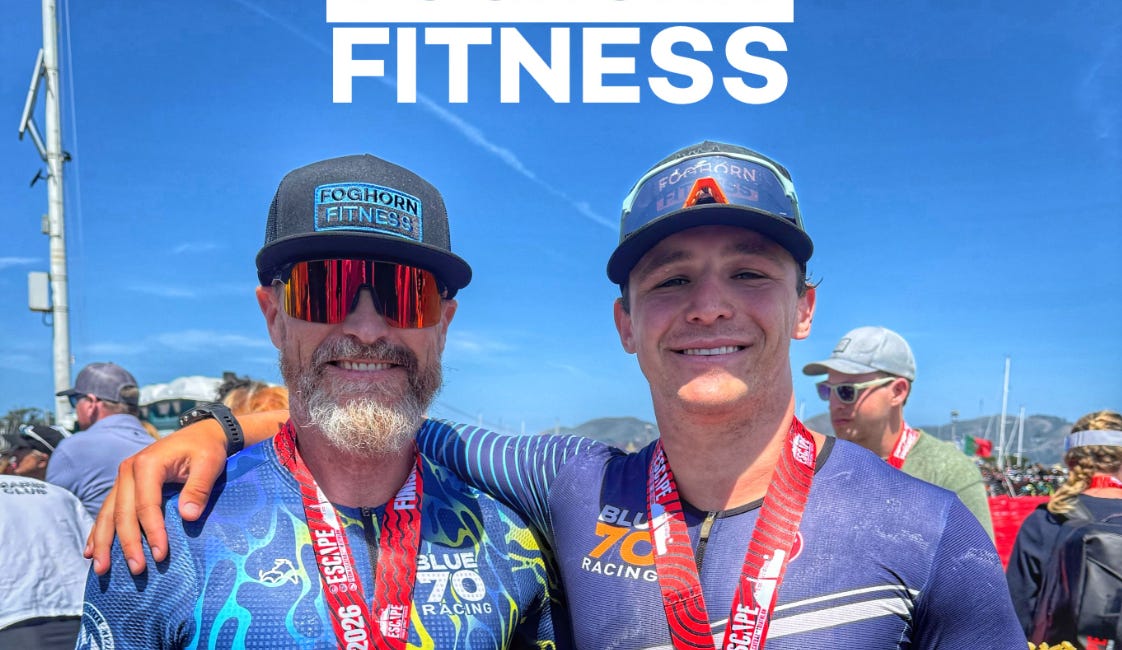
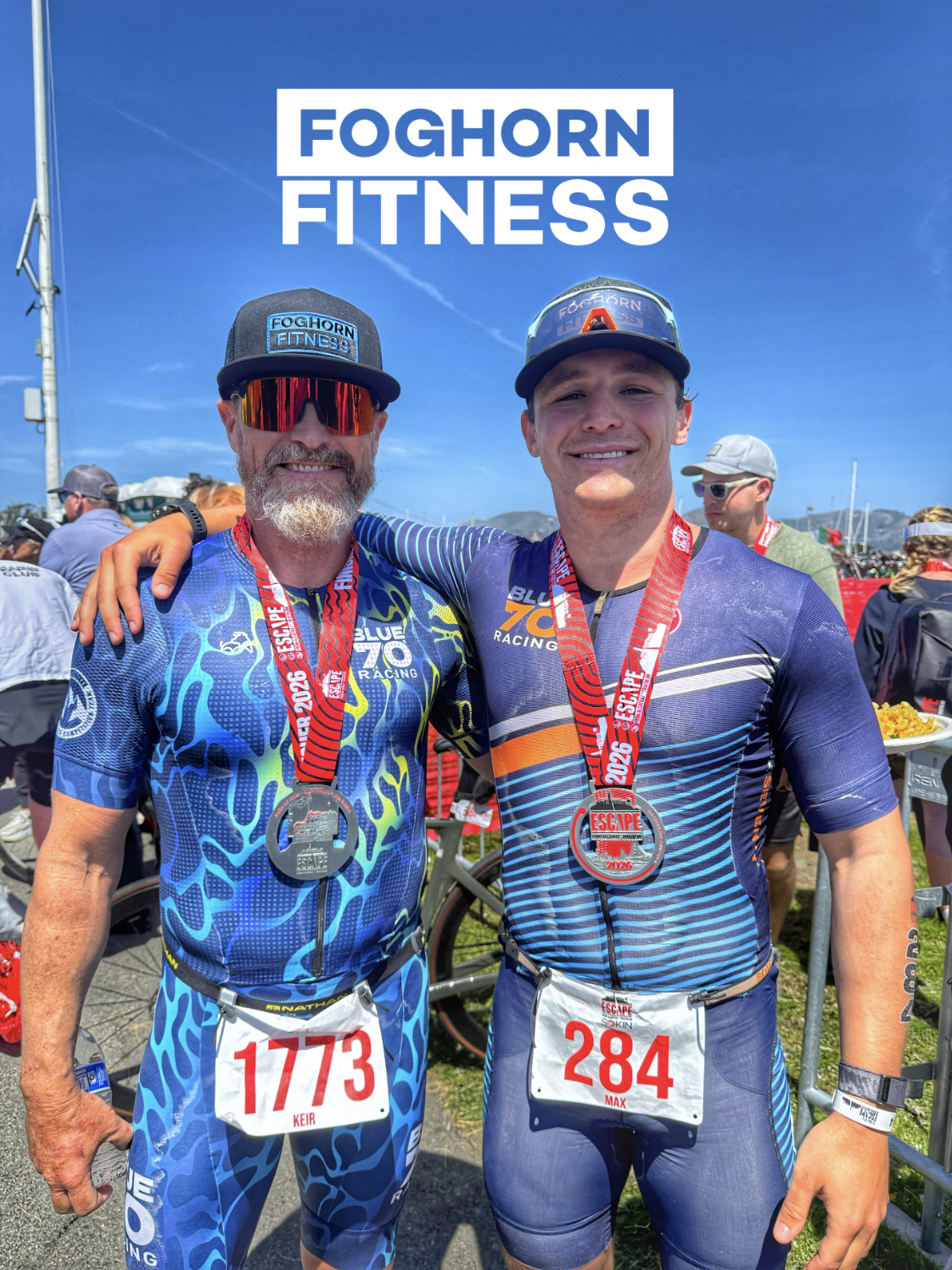
P.S. Speaking of walking, did a fair amount of that up the infamous Baker Beach Sand Ladder this past weekend during the 2026 Escape from Alcatraz Triathlon. Congrats, too, to Foghorn athlete (and eldest son) Max Beadling on his first triathlon (and on absolutely smoking his dad).

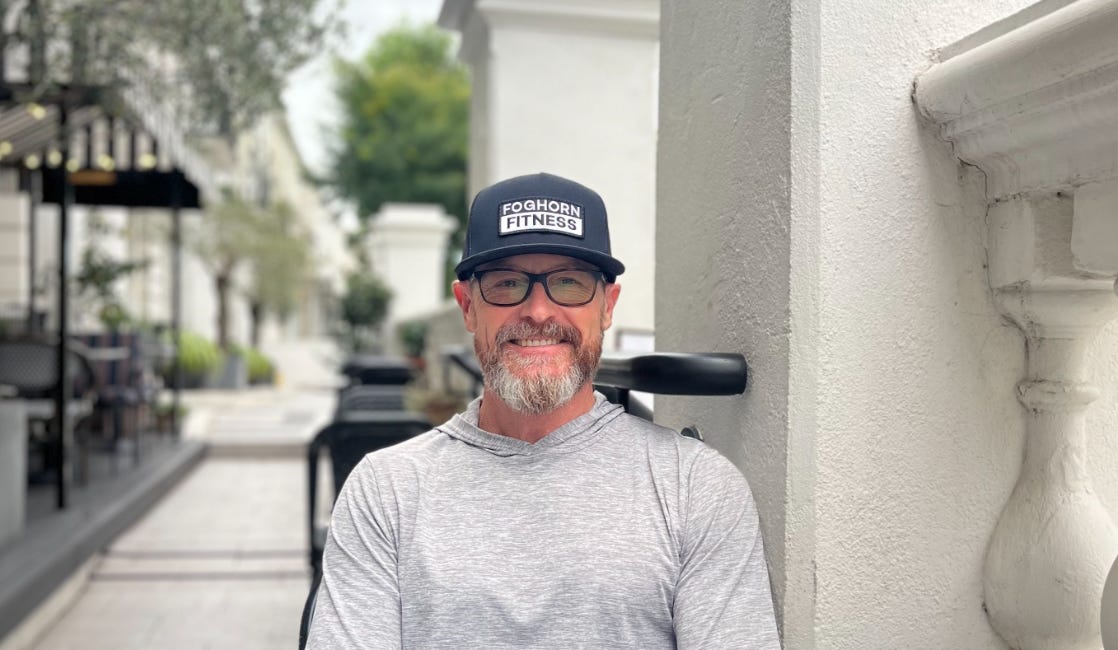
P.P.S. New website, new merch! Please have a look at the latest & greatest Foghorn website and if you’re interested in a new Foghorn hat (blue on black logo pictured above), let me know!